Better Voices:
A Tome of Stars Companion

Better Voices: Introduction
Better Voices is a Tome of Stars companion album featuring some of the most famous romance and love poetry in the English language set to new music.To accompany Stargazer's decidedly amateur verse, and he thought it worthwhile to add some music to those much better (and public domain) voices that nevertheless, in various ways in his mind, reflect facets of Tome of Stars, itself. These are "old" and very well-known poems, and therefore there exist extensive scholarly and lay analyses and discussions related to their meaning, use of language, allusions, etc. Many "better voices" have written extensively on these "better voices," and it would be both hubristic and wasteful for it to be repeated here. Instead, the analyses will be focused on why these poems were included, how they resonated with the story of the poet and the Stargirl (in his mind).
I Cannot Live with You
Emily Dickinson
I cannot live with You –
It would be Life –
And Life is over there –
Behind the Shelf
The Sexton keeps the Key to –
Putting up
Our Life – His Porcelain –
Like a Cup –
Discarded of the Housewife –
Quaint – or Broke –
A newer Sevres pleases –
Old Ones crack –
I could not die – with You –
For One must wait
To shut the Other’s Gaze down –
You – could not –
And I – could I stand by
And see You – freeze –
Without my Right of Frost –
Death's privilege?
Nor could I rise – with You –
Because Your Face
Would put out Jesus’ –
That New Grace
Glow plain – and foreign
On my homesick Eye –
Except that You than He
Shone closer by –
They’d judge Us – How –
For You – served Heaven – You know,
Or sought to –
I could not –
Because You saturated Sight –
And I had no more Eyes
For sordid excellence
As Paradise
And were You lost, I would be –
Though My Name
Rang loudest
On the Heavenly fame –
And were You – saved –
And I – condemned to be
Where You were not –
That self – were Hell to Me –
So We must meet apart –
You there – I – here –
With just the Door ajar
That Oceans are – and Prayer –
And that White Sustenance –
Despair –
Back when dashes were still cool.
For the poet, Dickinson's verse presents an intense love that cannot be fulfilled, either in life, death, or an afterlife. She runs through many scenarios about why, none of them directly relevant to the poet's situation. However, abstracted from the specifics, the overall tragedy and suffering of togetherness-denied strikes him as isomorphous. There are also echoes to Through the Fire in the inherent incompatibility of the union of the lovers. And the poem ends with a paradoxical description of the the despair the situation elicits as a “White Sustenance,” something that provides some kind of nourishment in the famine from denied affection, as if when all else is lost of the beloved, even the agony in the despair of it is at least a connection of some sort. This view parallels many of the poems in Tome of Stars that describe the poet’s continuing efforts to find some kind of link to the Stargirl, even if false or a fantasy, imagined or virtual (see Echo Chamber, Conference, 2024, Sempiternal, Oasis, and Simulacrum) where the poet is a “beggar” who “dares not question what’s bestowed,” who is “malnourished” at a “null feast.”
I think I should have loved you presently
Edna St. Vincent Millay
I think I should have loved you presently,
And given in earnest words I flung in jest;
And lifted honest eyes for you to see,
And caught your hand against my cheek and breast;
And all my pretty follies flung aside
That won you to me, and beneath your gaze,
Naked of reticence and shorn of pride,
Spread like a chart my little wicked ways.
I, that had been to you, had you remained,
But one more waking from a recurrent dream,
Cherish no less the certain stakes I gained,
And walk your memory's halls, austere, supreme,
A ghost in marble of a girl you knew
Who would have loved you in a day or two.
While the poet’s love for the Stargirl may have been a failure through his damaged psychology, it was always deep and earnest, soul- and life-changing. In this sense, the "gamesmanship" of St. Vincent Millay's emotional interactions and effects are utterly alien to him, incomprehensible emotionally, if analyzable intellectually. For him, besides the beauty of the language and imagery, he connects with this poem in the "might have beens" and "haunting" aspects. Despite St. Vincent Millay's fierce independence as a woman in relationships (shocking for her time), the poet detects elements of regret for a real connection between her and this lover. The final lines about her haunting him in some kind of rarefied, elevated (and ultimately unreal) manner “strikes close to home” with the life-long haunting of his heart by the Stargirl.
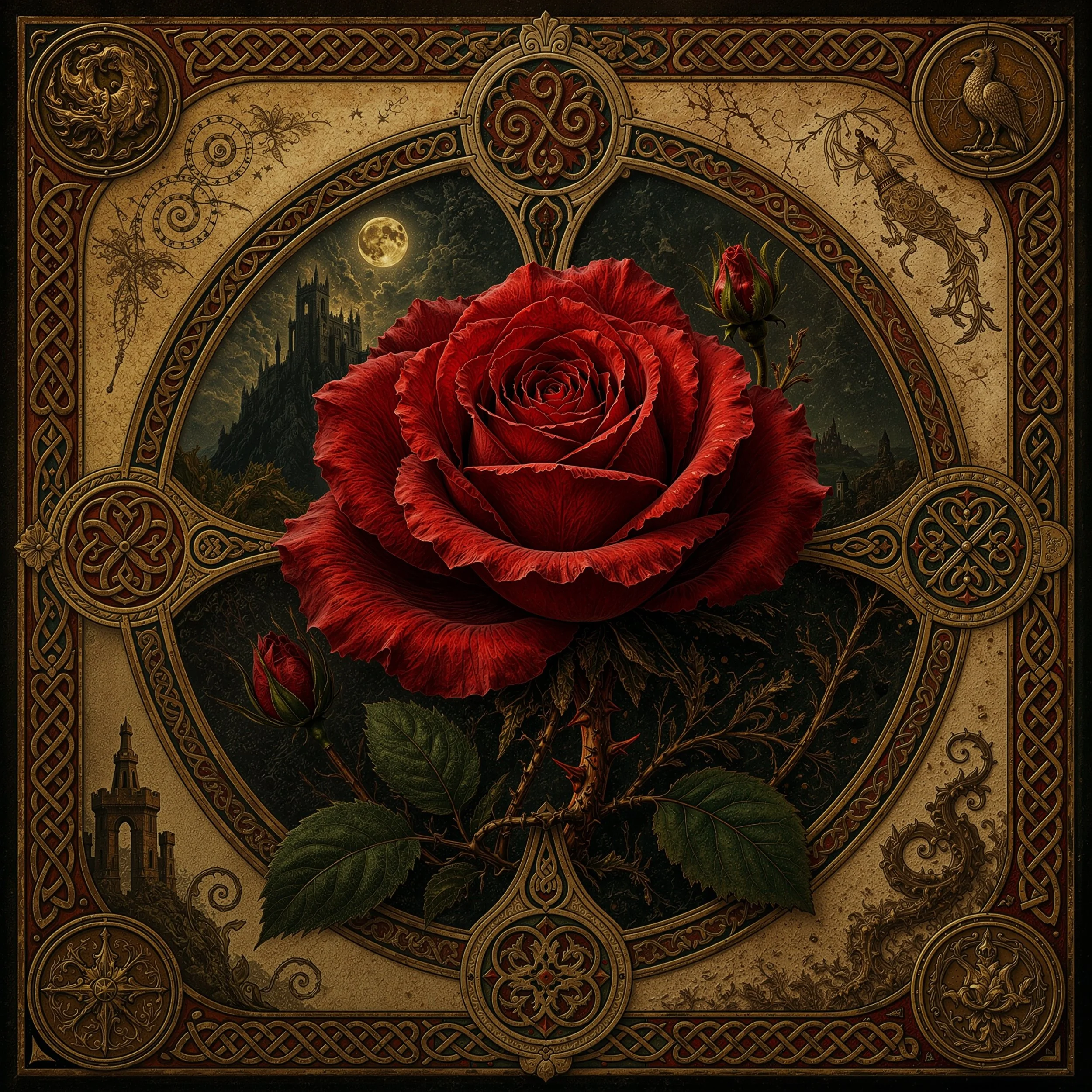
A Red, Red Rose
Robert Burns
O my luve's like a red, red rose,
That's newly sprung in June;
O my luve's like the melodie
That's sweetly played in tune.
As fair art thou, my bonnie lass,
So deep in luve am I;
And I will luve thee still, my dear,
Till a' the seas gang dry.
Till a' the seas gang dry, my dear,
And the rocks melt wi' the sun:
O I will love thee still, my dear,
While the sands o' life shall run.
And fare thee weel, my only luve,
And fare thee weel awhile!
And I will come again, my luve,
Though it were ten thousand mile.
First published in 1794 as a song (not a poem), this is a classic "in English literature textbooks" verse by the Scottish poet, Robert Burns. The lyrics and melody were assembled by Burns (and the music changing over the years as others adapted it) from traditional ballad elements and spread through chapbooks, schools, and oral performances and remains one of the most anthologized works in the English language.
For Stargazer, the poem represents a straightforward and raw encapsulation of many of the core elements of being in love. Nothing deeper than that, this powerful feeling of life and strength of feeling that consumes and overwhelms, and for him, incarnate in the fire that ran through him in the presence of the Stargirl.
Bright Star
John Keats
Bright star! would I were steadfast as thou art—
Not in lone splendour hung aloft the night,
And watching, with eternal lids apart,
Like Nature's patient sleepless Eremite,
The moving waters at their priestlike task
Of pure ablution round earth's human shores,
Or gazing on the new soft fallen mask
Of snow upon the mountains and the moors—
No—yet still steadfast, still unchangeable,
Pillow'd upon my fair love's ripening breast
To feel for ever its soft fall and swell,
Awake for ever in a sweet unrest,
Still, still to hear her tender-taken breath,
And so live ever—or else swoon to death.
One of Keat’s most admired sonnets (written in the final years of his very short life - around 1818-1819),, this poem is of course perfect for Stargazer to love from its stellar imagery to the aching and overwhelming emotion of being in the presence of a dearly beloved (and the horror of her absence). As absurd as the final line may seem to most, some poetic over-indulgence, it is very much the feeling he has regarding the Stargirl and which he has carried with him for decades, every day. Were it not for duties and responsibilities, and the ever present and unforgettable “hell meme,” such a path is the only one that seems to make sense in a cosmos inverted and made an empty source of suffering. The “bright star” is of course the north star, Polaris, the name of a poem in Tome of Stars, which is by no manner a coincidence.
Meeting and Parting
Robert Browning
The grey sea and the long black land;
And the yellow half-moon large and low;
And the startled little waves that leap
In fiery ringlets from their sleep,
As I gain the cove with pushing prow,
And quench its speed i' the slushy sand.
Then a mile of warm sea-scented beach;
Three fields to cross till a farm appears;
A tap at the pane, the quick sharp scratch
And blue spurt of a lighted match,
And a voice less loud, thro' its joys and fears,
Than the two hearts beating each to each!
Round the cape of a sudden came the sea,
And the sun looked over the mountain's rim:
And straight was a path of gold for him,
And the need of a world of men for me.
Meeting at Night and Parting at Morning first appeared together as Night and Morning in Dramatic Romances and Lyrics in 1845. Later editions separated the poems, but they have traditionally been read together as a pair. They detail a clandestine meeting between two lovers (Robert Browning and Elizabeth Barret, the latter who was basically living under home arrest by her tyrannical father who forbade any of this children to marry). This sense of secretive meetings in the face of the displeasure of elements of society is too familiar to the poet, although he had long before he met the Stargirl found the poems magnetic in the intensity conveyed from such meetings.
Forty Three
(Sonnets from the Portuguese 43: How do I love thee? Let me count the ways)
Elizabeth Barret Browning
How do I love thee? Let me count the ways.
I love thee to the depth and breadth and height
My soul can reach, when feeling out of sight
For the ends of being and ideal grace.
I love thee to the level of every day’s
Most quiet need, by sun and candle-light.
I love thee freely, as men strive for right;
I love thee purely, as they turn from praise.
I love thee with the passion put to use
In my old griefs, and with my childhood’s faith.
I love thee with a love I seemed to lose
With my lost saints. I love thee with the breath,
Smiles, tears, of all my life; and, if God choose,
I shall but love thee better after death.
How do I love thee? Let me count the ways is Sonnet 43 from Elizabeth Barrett Browning's 1850 sequence Sonnets from the Portuguese. It is one of the most beloved poems in English literature, written during her secret courtship with Robert Browning. The opening line is so well-known that it is often attributed to Shakespeare. While the details differ, Stargazer can intimately identify with the deep personal connection she feels with Browning, and it makes this poem an emotional touchstone to remind him that he is not alone with such deep feelings, even if his own pathologies led to the inverse fate of this blessed couple.
She Walks in Beauty
Lord Byron (George Gordon)
She walks in beauty, like the night
Of cloudless climes and starry skies;
And all that’s best of dark and bright
Meet in her aspect and her eyes;
Thus mellowed to that tender light
Which heaven to gaudy day denies.
One shade the more, one ray the less,
Had half impaired the nameless grace
Which waves in every raven tress,
Or softly lightens o’er her face;
Where thoughts serenely sweet express,
How pure, how dear their dwelling-place.
And on that cheek, and o’er that brow,
So soft, so calm, yet eloquent,
The smiles that win, the tints that glow,
But tell of days in goodness spent,
A mind at peace with all below,
A heart whose love is innocent!
Lord Byron’s She Walks in Beauty was written in 1814, inspired by his cousin by marriage, Mrs. Anne Beatrix Wilmot. He saw her wearing a black mourning gown adorned with sparkling spangles at a social gathering. There is no evidence that there was any romantic relationship (or even interest, whatever his reputation). The poem juxtaposes contrasts - light and dark, external and internal beauty, emotion and morality. For Stargazer, it is a poem written as if for the Stargirl, as much verse in Tome of Stars would attest. The stars are of course sparkling points of light in a black background, where his beloved did not just walk in beauty. She danced.
Sixty One
Sonnet 61, William Shakespeare
Is it thy will thy image should keep open
My heavy eyelids to the weary night?
Dost thou desire my slumbers should be broken,
While shadows like to thee do mock my sight?
Is it thy spirit that thou send’st from thee
So far from home into my deeds to pry,
To find out shames and idle hours in me,
The scope and tenor of thy jealousy?
O no; thy love, though much, is not so great.
It is my love that keeps mine eye awake,
Mine own true love that doth my rest defeat,
To play the watchman ever for thy sake.
For thee watch I whilst thou dost wake elsewhere,
From me far off, with others all too near.
Sonnet 61 by William Shakespeare is less famous than some of his other poems about love (e.g., Sonnet 18, Shall I compare thee to a summer’s day?, Sonnet 116, Let me not to the marriage of true minds, or Sonnet 130 My mistress' eyes are nothing like the sun), but scandalous heresy be confessed, Stargazer was not commonly moved emotionally by the Bard's verse (while of course fully appreciative of his skill with words), but #61 hit with more impact after his loss of the Stargirl. The speaker's torment at night seeing shadows resembling the beloved, his agony at waking alone and knowing every morning she woke beside others, the sheer madness it induces—such sentiment is all too familiar. Producing a musical lament in a sludgy-grunge style seemed the perfect adaptation for such daily hell.