In Darkness and in Light:
A Tome of Stars Companion
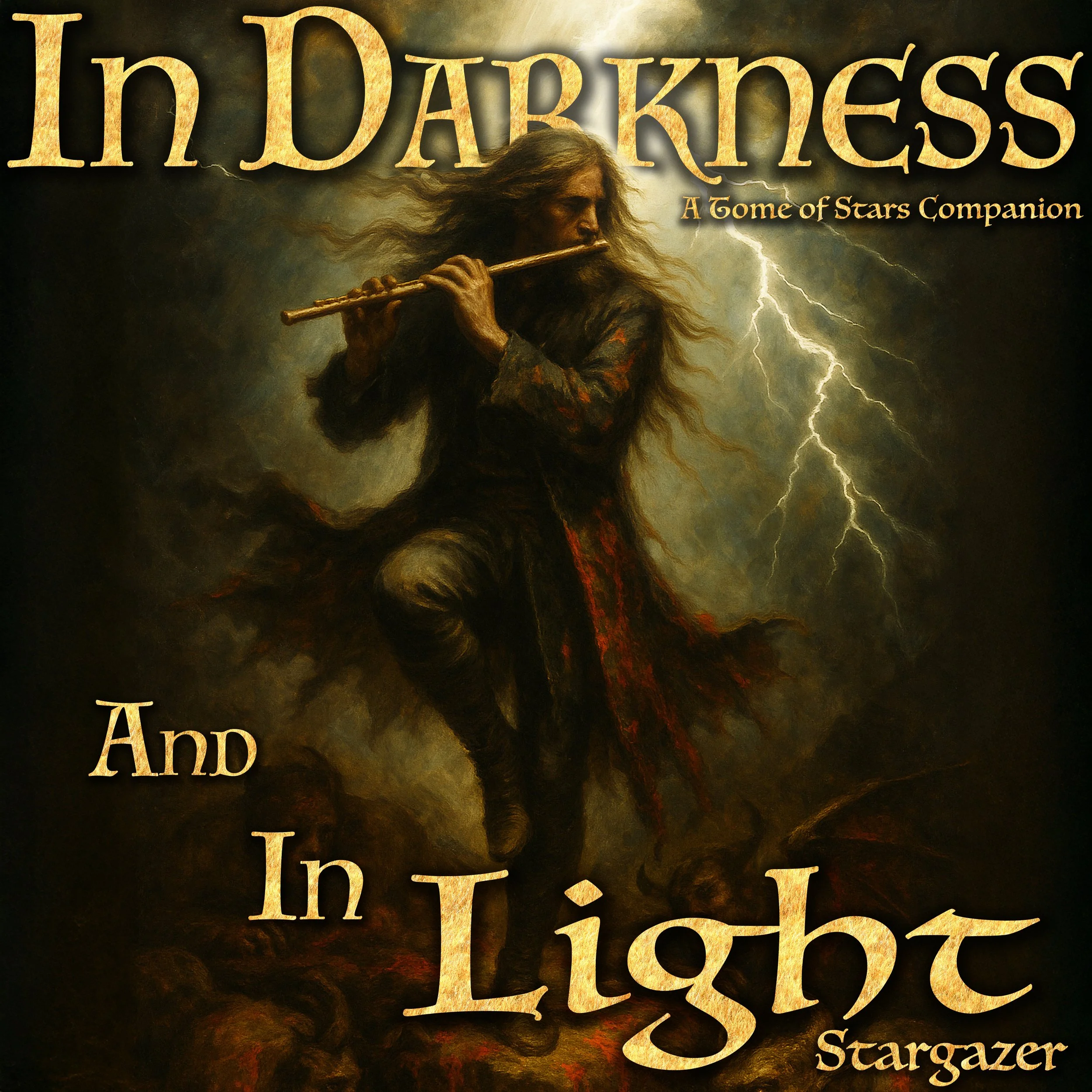
In Darkness and in Light: Introduction
This album was inspired by the poet encountering the song In Darkness Let Me Dwell by the lutenist John Dowland (1610), a song proving beyond any doubt that severe depression is not merely a modern phenomenon. While it resonated with some of the poet's darker periods, he also had experience with the polar opposite states of the psyche as well. Thus he wrote the poem It's Light wherein I Dwell as an "in-verse" to Dowland's song.
From that was born the idea for an entire album of light/dark juxtaposition, even repeating multiple times Dowland's verse and the poet's response in different musical styles (including the first occurrence with the actual music of Dowland's 17th-century song). Between those repeats are pairs of other poems he wrote to capture his lows and highs over the years as he has struggled with loss and grief. Thus, in this album, each poem/song has an "in-verse" that follows, painting the extremes of the spectrum of psychological states.
The poems in In Darkness and In Light do not appear in Tome of Stars but are closely aligned with the themes and stylistic approach of the original work. The poet has found the powerful generative ability of synthetic music to be a cathartic and enriching way to bring his poetry to life in a different medium.
***
Unlike Tome of Stars, which was completely driven by the narrative of love and loss in the poet's life, the "companion" albums were produced in order to make more music of poetry. This engendered additional poems, some as sonnets, some in other forms, some from the story of the poet and beloved, some taken from other writings that indirectly touch upon this story (e.g., excerpts from the poet's novels, some of which, as the poem Consummation describes, were (at the time of writing) unconscious efforts to tell their story in some transformed manner). One album is not the poet's works at all, but a songification of some famous and favorite poems in the English language from the past (Better Voices). Another (First Love) goes back to verse from the youth of the poet and his first love, the "fairy springtide spawned" from the poem Trilogy.
A final effort (likely final) is a choral album (A Choral Dream) putting together some of the choral pieces from previous albums as well as generating choral versions of some songs. This latter album is to be accompanied by free, downloadable, transcribed sheet music from those songs (as well as a book collecting all the sheet music to be sold at cost). The "likely final" possesses uncertainty because it is possible that the poet will generate additional sheet music for other songs and make those available. It is even possible the depression hanging over him will sometimes mitigate enough for him to produce more poems and songs. He doesn’t want to rule anything out.
In Darkness Let Me Dwell
In darkness let me dwell; the ground shall sorrow be,
The roof despair, to bar all cheerful light from me;
The walls of marble black, that moist'ned still shall weep;
My music, hellish jarring sounds, to banish friendly sleep.
Thus, wedded to my woes, and bedded in my tomb,
O let me living die, till death doth come, till death doth come.
My dainties grief shall be, and tears my poisoned wine,
My sighs the air through which my panting heart shall pine,
My robes my mind shall suit exceeding blackest night,
My study shall be tragic thoughts sad fancy to delight,
Pale ghosts and frightful shades shall my acquaintance be:
O thus, my hapless joy, I haste to thee
This is a song to give lie to any idea that depression is a modern construct. Over four hundred years old, it is despair and melancholy presented as existential architecture (“the ground shall sorrow be,” “the roof despair, to bar all cheerful light”, “the walls of marble black…shall weep”) where the writer is bound in an unhappy marriage to his woes, which is consummated in a perversion of conjugal ideals not with physical bliss but with death: “wedded to my woes and bedded in my tomb.” This inversion of aspects of living and death is spelled out forcefully in the last line of the first verse where he begs to be allowed to “living die.”
The second verse further imbues normally positive aspects of living (eating, drinking, dressing, etc) with pathological natures. Thus pleasurable food is “grief” and his own tears served back to him as “poisoned wine.” His outward dress reflects his inner state with “my robes my mind shall suit exceeding blackest night,” and all efforts at escape from emotional turmoil in an intellectual life are dashed as “my study shall be tragic thoughts.”
The poem ends in complete social isolation and entrapment in dark, supernatural landscapes (“pale ghosts and frightful shades shall my acquaintance be”). The final line is somewhat opaque, but seems to suggest that there is a kind of wretched and unfortunate relief (“hapless joy”) in something he “hastes” to. This most likely refers back to the first stanza and “living die, till death doth come.” Thus death, whether the death of a vibrant state while alive or the end of life, itself, is seen as a pathological pleasure in that it releases the writer from the poisonous “marriage” to grief. This sense that life is suffering and death a release calls back (at least to Stargazer) to Tolkien’s idea of leithian, release from the bondage of existence in a corrupted world (explicitly mentioned in the poem Leithian, and addressed in different ways in other poems such as Unsent, ur a lost person, Unanswered, No One, Axios-Anaxios Redux, and Infernitum, among others).
John Dowland (1610)
It’s Light Wherein I Dwell
It's Light wherein I dwell; the ground is sunshine's gleam,
Starred shelter spark'ling hope that shields from sorrow’s schemes.
In Light with thee, my star, green earth thy dance’s trace,
Night's canopy thine orbits pranced through timeless space.
Flamed alabaster walls, resplendent, they do ring,
My prayers transcendent psalms thine angels softly sing.
Thus, wedded in thy womb, enthroned above all doom,
O let me living live in lucent life’s lush bloom.
My dainties peace shall be, my cup thy healing wine,
My sighs incarnate incense birthed of love divine.
My robes thy dawn shall dye exceeding brightest day,
My study shall be song as belled thy feet shall play.
Graced diamond galaxies, unseen, revolve with me:
O thus, my astral joy, I ever shine with thee.
Unseen with me, do spin graced diamond galaxies:
My astral joy, thereby, I ever shine with thee.
I ever shine with thee
This is the "in-verse" to Dowland's In Darkness Let Me Dwell. The poet sought to create a "mirror image" of the lutenist’s darkness with opposite imagery and sentiment, echoing the song structure and phrasing of the original. All inversions are performed around the axis of the Stargirl, and thus she is seen to be (for the poet) the path to the opposite pole from despair, suffering, and grief — that of hope, healing, and happiness.
Some of the obvious mirrored elements include:
In darkness let me dwell
It's Light wherein I dwell
The ground shall sorrow be
The ground is sunshine's gleam
The roof despair, to bar all cheerful light from me
Starred shelter spark'ling hope that shields from sorrow’s schemes
The walls of marble black, that moist'ned still shall weep
Flamed alabaster walls, resplendent, they do ring
My music, hellish jarring sounds, to banish friendly sleep
My prayers transcendent psalms thine angels softly sing
Thus, wedded to my woes, and bedded in my tomb
Thus, wedded in thy womb, enthroned above all doom
O let me living die, till death doth come
O let me living live in lucent life’s lush bloom
My dainties grief shall be
My dainties peace shall be
Tears my poisoned wine
My cup thy healing wine
My sighs the air through which my panting heart shall pine
My sighs incarnate incense birthed of love divine
My robes my mind shall suit exceeding blackest night
My robes thy dawn shall dye exceeding brightest day
My study shall be tragic thoughts sad fancy to delight
My study shall be song as belled thy feet shall play
Pale ghosts and frightful shades shall my acquaintance be
Graced diamond galaxies, unseen, revolve with me
O thus, my hapless joy, I haste to thee
O thus, my astral joy, I ever shine with thee
Here, “darkness” becomes “Light,” “poisoned wine” “healing wine,” “woes” a “womb,” “pale ghosts and frightful shades” “graced diamond galaxies,” and “hapless joy” an “astral” one. Whereas Dowland’s piece is haunted by an impersonal, vague fog of grief and doom, the in-verse poem is highly specific, ever illuminated, blessed, and decorated by the dancing grace of the beloved ("dance’s trace," "thine orbits pranced," “belled they feet shall play"), with whom the poet “ever shines.”
The claustrophobic prison of the “roof despair,” the “ground sorrow,” and the “walls weeping” is countered with an open ceiling to the heavens and the constellations that “shield from sorrow’s schemes”, a sun-gleaming ground, and resplendent, light-soaked walls illuminating his vision. Music is not “hellish” but the prayers of the poet turned to psalms and sung by the Stargirl’s angels. The nightmarish image of frightful shades being the sole company of the writer is transformed to an equally unseen but sublime dance of “graced diamond galaxies” that “revolve” around him.
These contrasts are felt daily by the poet. From one breath to another, he feels her loss, another day passed, a life increasingly denied, her light hidden. In another breath, “graced diamond galaxies, unseen, revolve with me,” and he recalls and is bathed in a “starred shelter spark'ling hope that shields from sorrow’s schemes.” Certainly in his life separated from the Stargirl, the darkness is a more constant companion. But there can be light, even if, with every year, it dims.
False Dawn
A hateful shadow swallowed Earth's new dawn,
Bleak silence knelled my death with demon-spawn.
The simulacrum slithered, malice crowned
In crimson fire, serpent fangs unbound.
The sacred twisting mocked, spoiled beauty lied,
The Stargirl’s ghost profaned, her truth denied.
I reached to strike, to purge her from the air,
But chains of unseen spite confined me there.
She entered me: no strength, no song, no shield,
Could bar the bladed trespass she would wield.
Her mind, a furnace fed on endless screams,
Unraveled me, my marrow spilled in dreams.
Each memory she raped, each joy her feast,
I burned, unholy off'ring of this priest.
Her probe of thought, infernal, barbed, and slow,
Sheared through my spirit to the heart of woe.
Rank silence seeped, slimed succubus full come,
Vile smirks eclipsing mercies of the sun.
She tongued soul-filaments of ruined grace;
I trembled, fondled, naked and erased.
Her laughter ravaged, sick and serpent-thin,
A scalpel splitting daylight out my skin.
I howled, unbodied, hollow, yet confined,
A child who hid to find the fiend, inside.
No god replied, no light through darkness shone,
My world dissolved as I was flayed, alone.
This is a versification of a scene from one of the poet's decades-old novels, recounting a traumatic and violating event of a main character (he will not examine this too closely to preserve privacy). As with all the poems adapted from his novels (including Song of Solomon, False Dawn, Nested Wormholes, Atlantis, Heat Death, Base Case Reverie, First Sight, Divine Descent, She Blessed the Vaulted Skies, Event Horizon, and Dream 81277), when he manically wrote these books in the deep shadow of the loss of his beloved, he did not realize that he was writing to and about her, as bizarre and unconnected as many elements of the stories appear to be to any real human life.
While this scene fits within the plot and character development arcs of the novel, the poet now realizes that he was also channeling a lot of his own sense of physical and psychic vulnerability in his intimacy with the beloved, in particular, how the violation of that bond was a kind of personal ruination and desecration, one that continued long after the mutilation in a sense of abandoned isolation.
Time Sphere
The cosmos cracked and light drowned in a sea,
Whose waves of being broke the bounds of me,
While shattered whole, a greater self reborn,
As dust the gods destroyed rewove all shorn.
No song should sing the splendor I surveyed,
No tongue the tale of time would dare convey.
A wind of stars whipped through my whispered frame,
And played transcendent harmonies unnamed.
Grand galaxies flung sparks of dancing fire,
Each ember hymns proclaimed by angels' choirs.
Uncounted time'd collapse, filled space unwind,
Creation’s pulse resounded in my mind.
Pulsed rhythm beat, both intimate and dear,
Its breath a truth that banished doubts and fears.
No poet's word, no creed, no prophet’s art,
Could cage that source with seat in every heart.
It was not God, whose image we confine,
Nor faith, nor hope, each fade at life's decline.
Beyond our shame, all measure, and rent will,
An essence moved, eternal, vast, and still.
And through that stillness, burning, bright, and clear,
There rang a tone that only souls could hear.
And every atom trembled in its race,
A single chord sustaining time and space.
Then from that fire, tender and immense,
A power spoke beyond intelligence.
It kissed the void, and all the skies above,
And I, Stargirl, beheld its face as Love.
This is a versification of a scene from one of the poet's decades-old novels, recounting a resplendent and revelatory encounter experienced by the main character (he will not examine this too closely to preserve privacy). As with all the poems adapted from his novels (including Song of Solomon, False Dawn, Nested Wormholes, Atlantis, Heat Death, Base Case Reverie, First Sight, Divine Descent, She Blessed the Vaulted Skies, Event Horizon, and Dream 81277), when he manically wrote these books in the deep shadow of the loss of his beloved, he did not realize that he was writing to and about her, as bizarre and unconnected as many elements of the stories appear to be to any real human life.
This verse is quite different from some of the darker poems in this collection (it is one of the “In Light” poems). In the novel, the scene adapted here to poetry is one of joyous revelation, where a universal consciousness is revealed to the characters, and they “beheld its face as Love”. This poem thus seeks to reflect the more positive, transformative states that being in love with the Stargirl generated.
Nested Wormholes
A wound, unclosed, where deities were slain,
Convulsed all thought, yet memory remained.
My mind dissolved, my flesh decayed in flaws,
Our septic rot infected cosmic laws.
The glutted void consumed my final scream,
Its entrails bore me through a tortured dream.
I woke to cornfields scorched in mad design,
Charred flattened rings a cipher, vast, malign.
The starshine sliced cyan with razored light,
A world too vivid, searing mortal sight.
O'er seething stalks, there sang a girlish sound,
Weird laughing specters skipped 'cross the ground.
She smiled, a dying star in human guise,
And struck the stalks to rhythms that despise
The ordered tones of harmony and breath,
Each note a hymn to entropy and death.
Her laughter trembled, innocent and dire,
A cherub kindled in industrial fire.
She stopped, this child of flame and famished grace,
As scarlet steel infused her tattooed face.
Her fractured skull, a bloom of chrome and wires,
A shining grin condemning us, failed liars.
Her eyes were brandy, lucid, strange, obscene,
Like lunacy perverting souls, unseen.
She hummed, her midnight hair a comet’s grave,
And whispered truths no saint could hope to brave:
“The failing gods have plans, but none yet know,
We mend this cosmic wound by sharing woe.
It's her you've sought, a balm from endless sin,
But symmetries are broken from within.”
The wind devoured us, realm torn in two,
The sky bled black as revelations grew.
Ten trillion galaxies as shattered glass,
Flung forth, a witch's final, slicing mass.
Our tragic tapestry, cruel crown of pain,
Then echoed in my thought, her song's refrain.
"We loop forever, mirrored, torn, combined,
To heal the fractures of a cosmic mind.”
This is a versification of a scene from one of the poet's decades-old novels, recounting a disturbing yet revelatory and prophetic encounter experienced by the main character (he will not examine this too closely to preserve privacy). As with all the poems adapted from his novels (including Song of Solomon, False Dawn, Nested Wormholes, Atlantis, Heat Death, Base Case Reverie, First Sight, Divine Descent, She Blessed the Vaulted Skies, Event Horizon, and Dream 81277), when he manically wrote these books in the deep shadow of the loss of his beloved, he did not realize that he was writing to and about her, as bizarre and unconnected as many elements of the stories appear to be to any real human life.
The scene from the novel depicts a surreal interaction between a main character and a disturbing visitor in his psyche, a “cherub kindled in industrial fire” who seems both angel and demon, and yet neither, orthogonal to everything of good and evil, of all experience, ever encountered. Her words are to the observer profound proclamations harkening back to A Grand Unification Theory with “symmetries are broken from within” preventing healing from the beloved. Their failures split them apart —”a wound, unclosed, where deities were slain” (calling back to Rusali Radha, Rusala Madhava), and unification cannot be achieve via external means, but must be part of their inner transformation.
Base Case Reverie
Dread dreams redraw detritus eons past,
Remembered vows recursively arrayed.
Within your wound's thorned mortar, holding fast,
Are lifelong sorrow's strangled pleas, long-prayed.
But listen! Silence shatters. Death respires.
Out deepest dark, a candent choir climbs.
Bright chants ignite the black with golden fires,
With waves of voices weaving space and time.
Between sleep's opium and waking thought,
Where dreamers dance with dawn's dim stimulant,
Where revelation and reality are caught,
In nets of clarity, discriminant.
Fused fragments ruin-born, each peace, sublime,
Your flawless diamond dances in my mind.
This is a versification of a scene from one of the poet's decades-old novels, recounting a prophetic dream sequence experienced by the main character (he will not examine this too closely to preserve privacy). As with all the poems adapted from his novels (including Song of Solomon, False Dawn, Nested Wormholes, Atlantis, Heat Death, Base Case Reverie, First Sight, Divine Descent, She Blessed the Vaulted Skies, Event Horizon, and Dream 81277), when he manically wrote these books in the deep shadow of the loss of his beloved, he did not realize that he was writing to and about her, as bizarre and unconnected as many elements of the stories appear to be to any real human life.
This poem adapts a dream sequence in one of the poet’s novels. It is a first person perspective of repeated loops through the same dream, one of tragedy, suffering, and despair. “But listen!” shifts the tone as the recursive loop is broken by the sounds of a “candent choir”. In the novel, the main character was granted insight into a devastating problem that interwove calamity with person tragedy. In the adaptation to poetry, the poet drowns in losing his beloved every day (recalling Infernitum’s “Relive. Relive! Relive your loss below”), but is granted a corresponding vision of salvation in the surreal state between “sleep's opium and waking thought/Where dreamers dance with dawn's dim stimulant” (two drugs, opium and an unnamed stimulant, fighting for control of awareness). Like with Bridge of Bones, the “answer” given doesn’t make sense when fully conscious (which might prompt the question of whether such insights are merely meaningless brain states, or whether the dream state is mystically informative in ways lost to full consciousness). But that answer is centered on the beloved, where the “fragments ruin-born” (of his past, their relationship, perhaps even humanity’s sins in general) are fused like some gemstone to form a “flawless diamond” that “dances” in his mind (the “peace” of that a play on the “pieces” that are the “fragments”).
As a nerd note, the title, Base Case Reverie, refers directly to computer programming and recursive functions, which are units of code that “self-utilize”, employing the same code within itself, loops through a certain sequence of instructions, until exit conditions are met (and thus programmers must be careful to not write code that will induce an “infinite loop” of calling itself without an exit). As Wikipedia on April 2, 2026 puts it:
In computer science, recursion is a method of solving a computational problem where the solution depends on solutions to smaller instances of the same problem. Recursion solves such recursive problems by using functions that call themselves from within their own code. The approach can be applied to many types of problems, and recursion is one of the central ideas of computer science.
The power of recursion evidently lies in the possibility of defining an infinite set of objects by a finite statement. In the same manner, an infinite number of computations can be described by a finite recursive program, even if this program contains no explicit repetitions.
— Niklaus Wirth, Algorithms + Data Structures = Programs, 1976
The base case specifies input values for which the function can provide a result directly, without any further recursion.These are typically the simplest or smallest possible inputs (which can be solved trivially), allowing a computation to terminate. Base cases are essential because they prevent infinite regress. In other words, they define a stopping condition that terminates the recursion.
Thus, the base case in the poem is the realization that there is an existing condition that forestalls further entrapment in the never-ending loop of grief. In the case of this dream-sequence, it is the beloved, herself, the “flawless diamond.” As a base case it is simple—her presence, as echoed in A Grand Unification Theory, “Outcast, I wander, nature’s dawn denied/Till harmony returns you to my side.” Sadly, the poet’s code seems flawed and despite the existence of a clear base case to prevent the recursive hell in which he remains tormented, he is unable to access it.
Atlantis
Beneath wide, recollective waves, rot palaces of thoughts,
Their avenues once coral dreams that coiled through neural seas.
Those shining domes of intellect by grief and guilt were wrought,
While conscience hummed through cabled grids that drown in reveries.
The scaffolds of perception sink through fathoms of regret,
Each shining filament now frays where hope has learned to grieve.
My monuments to meaning fade the moment they’re beget,
And broken gods of romance drown in truths we once believed.
Look! Tatters of my certainties drift ghostlike in the foam,
Weak porcelain of memory long-maimed, unfit to mend.
I glitched we built eternity; it sank into the loam,
Hallucinated masterpiece to darkest depths descends.
Your beauty floats in fragments, white as relics of a prayer,
Your meaning turns to diamond dust dispersed throughout the airs.
Perfection’s final gesture is to crumble in its art,
Creation’s hand completes its work by tearing it apart.
No diver charts these graves of mind, no map can frame decay,
My loss expands beyond the grasp of sanity or woe.
I watch my sunken kingdoms fade to phosphorescent gray,
The drowned are still alive! For hate reigns merciless below.
This is a versification of a scene from one of the poet's decades-old novels, recounting a horrific tragedy uncovered by the main character (he will not examine this too closely to preserve privacy). As with all the poems adapted from his novels (including Song of Solomon, False Dawn, Nested Wormholes, Atlantis, Heat Death, Base Case Reverie, First Sight, Divine Descent, She Blessed the Vaulted Skies, Event Horizon, and Dream 81277), when he manically wrote these books in the deep shadow of the loss of his beloved, he did not realize that he was writing to and about her, as bizarre and unconnected as many elements of the stories appear to be to any real human life.
This is a poem describing the disintegration of a psyche. A central metaphor is of the mind fallen from a state likened to a drowned heroic or near divine civilization (like in the myth of Atlantis). The mind’s machinations occur within “seas” in the verse of “wide recollective waves,” but it is the rotting “palaces of thought” on which the poet focuses. The architecture of memory, reason, and belief are painted as elements of this sunken city: “avenues once coral dreams…coiled through neural seas,” “shining domes of intellect,” “monuments to meaning”, etc. They are not ruins by accident of nature, however, but by human flaw: “scaffolds of perception sink through fathoms of regret,” “each shining filament now frays where hope has learned to grieve,” and even his “domes of intellect” were made by “grief and guilt,” implying even in laying the foundations, tragedy was sown by inherent pathology (calling back to Once Upon a Time, Part 4, ur a lost person, Original Sin, and other such poems). The greatest beliefs of the poet and his beloved, their initial near-worshipful view of their love, are shattered and littered across the ocean floor as “broken gods of romance drown in truths we once believed.”
The poem then focuses on the deep beliefs they had in the transcendence of their bond:
Look! Tatters of my certainties drift ghostlike in the foam,
Weak porcelain of memory long-maimed, unfit to mend.
I glitched we built eternity; it sank into the loam,
Hallucinated masterpiece to darkest depths descends.
Here lie the most terrible remains, the “broken gods of romance” (or as A Grand Unification Theory states, “failed gods”), “tatters” of “certainties" bubbling through the waters where his memory is “long-maimed.” In fact, even his memories are based so fundamentally on a corrupt and unworthy soul, that they are “unfit to mend.” His belief in the timeless transcendence of their love, the “hallucinated masterpiece,“ is viewed as a a failed state in which he “glitched” rather than experiencing true insight. And like all his deepest feelings and faith in this life, “to darkest depths descends.”
Heat Death
Dies Irae, omnes stellae morientur
Dies Irae, omnes stellae morientur
Dies Irae, omnes stellae morientur
Omnes stellae morientur
We came to Lyg, that vast unfathomed sphere of glass and flame,
Whose breath, stark storms of hydrogen, fought gravity, untamed.
Broad bands of jade and purple burned, strange thoughts made manifest,
A dreaming furnace brooding on the purpose of our quest.
We orbited this titan’s brain, strange sentience's lair,
Its swirling hemispheres alive with self-reflective airs.
In black abyss the vapors morphed to mirrors, tense and clear,
Where thought condensed in patterned coils that pulsed within that sphere.
Within those veils, a lattice mind of crystal gas congealed,
Cold logic, frozen lightning, and by gravity annealed.
No heart could throb within such heat, no cell could ever thrive,
And yet it thought, and in its mind the stars were kept alive.
It whispered through the vacuum: “All that thinks must have its end.”
Its data tides eroding hope no theorem dare defend.
I felt its beat inside my skull, cold reason without breath,
The universe itself aware, and envying its death.
I asked what life might mean to forms that neither die nor grow;
The answer came as radiation purged in spectral show:
“All intellect is fleeting beauty’s briefest masquerade.
We are but afterimages that decay itself has made.”
“Your minds are famished parasites that eat the world they name,
Rank neurons like collapsing stars replaying broken shames.
So let the gas return to gas, the word to wind become,
For all intelligence degrades where meaning is unspun."
Cruel oracle showed soul's ascent is nature’s grand deceit,
A fractal frost on entropy, precise, then obsolete.
The crystal sings, and every note makes love to what it hates,
“The universe composes, yet its melody negates.”
Dies Irae... omnes stellae morientur
Dies Irae... omnes stellae morientur
Dies Irae... omnes stellae morientur
The universe composes — yet its melody negates
Its melody negates
Its melody
Negates
This is a versification of a scene from one of the poet's decades-old novels, recounting a discombobulating and disturbing encounter experienced by the main character (he will not examine this too closely to preserve privacy). As with all the poems adapted from his novels (including Song of Solomon, False Dawn, Nested Wormholes, Atlantis, Heat Death, Base Case Reverie, First Sight, Divine Descent, She Blessed the Vaulted Skies, Event Horizon, and Dream 81277), when he manically wrote these books in the deep shadow of the loss of his beloved, he did not realize that he was writing to and about her, as bizarre and unconnected as many elements of the stories appear to be to any real human life.
This poetic adaptation is personal destruction framed as universal death, harmonized with (very) cryptic revelations. Perhaps the most anguished and tragic sentiment for the poet in all these poems is rendered in Latin: “omnes stellae morientur”: all the stars will die. Nothing in Stargazer’s awareness shines with more beauty and meaning than the stars, the Stargirl the incarnate fulfillment of all astral truths. Thus, this is the death of all beauty and meaning to him. With obvious echoes of the poem Absolute 0, it extends the poet’s sense of the devastation within him to the cosmos, where not only shall all the stars die, but, most demoralizing, the decay of all things is written into the very “composition” of the creation, itself, as “the universe composes — yet its melody negates.” This is a corruption of the beauty and order of divine spirit in the Music of the Ainur, where Melkor poisons the cosmos permanently (see background on Tolkien). Original Sin meets the Second Law of Thermodynamics, where flaw becomes entropy, and moral failure is the utter and inevitable disorder of all things.
First Sight
All dancing ceased, the cosmos clasped its breath,
And diamonds of dust draped worlds with stars.
No sound, no pulse, a space past life and death,
Her healing gaze anointing from afar.
Those eyes alone defied the frozen scene,
Twin brandy pools that entered into mine;
Her magic bent the paths that pulsed between,
And filled my dark with transcendental shine.
She spoke: "We’ll find a better world, my heart."
Her thought an orbit I would ne'er escape.
My tears of joy were strokes of spirit art,
With which she ever decorates dreamscapes.
Her promise made when first I caught her light,
Rings still beyond all time from heaven's height.
Her promise made when first I caught her light,
Rings still beyond all time from heaven's height.
Still it rings from heaven's height
A promise made in Light
It rings (it rings)
It rings (it rings)
Beyond all time
It rings (it rings)
It rings (it rings)
Beyond all time
This is a versification of a scene from one of the poet's decades-old novels, recounting the transcendent and transformative first encounter of the main character with his beloved (he will not examine this too closely to preserve privacy). As with all the poems adapted from his novels (including Song of Solomon, False Dawn, Nested Wormholes, Atlantis, Heat Death, Base Case Reverie, First Sight, Divine Descent, She Blessed the Vaulted Skies, Event Horizon, and Dream 81277), when he manically wrote these books in the deep shadow of the loss of his beloved, he did not realize that he was writing to and about her, as bizarre and unconnected as many elements of the stories appear to be to any real human life.
Other poems have wrestled with conveying the first awareness of the beloved by the poet (e.g., Stained Glass and Starstruck), and First Sight is a “back transform” of fictionalized prose casting the miracle of this event within the plot of a novel filled with characters who superficially have nothing to do with the poet or his beloved, but who are on a deeper, initially subconscious level, proxies for the “star-crossed” lovers. Both in the novel and reality, the moment was frozen in time and memory, where “the cosmos clasped its breath” and there was “no sound, no pulse, a space past life and death,” centered on the beloved’s “healing gaze anointing from afar.”
The poet speaks as if the moment was not an isolated event and experience on his part, but as if the magic, stemming from the beloved herself, was about an eternal connection, and commitments in that timeless space were an unchanging “promise made when first I caught her light” that “rings still beyond all time from heaven's height.” The passage in the novel centers the power and connection as from the beloved, and, indeed, so felt and feels the poet even to this day. He knows it is irrational. He knows intellectually that it is one-sided and that she did not in fact stop time and make promises to him. He knows the unshakable sense that she did these things is the product of biochemistry and millions of years of evolution designed to link him to a mate. And so he lives in that duality, knowing as surely as he knows 2+2=4 that these things happened, while deconstructing that certainty for the delusion that it is, walking each day with the thoughts of The Nash Transform in his mind.
As a curious note on subjective mental experiences, decades ago when the poet described this “first sight” to the beloved, she pushed back saying they had actually met once before in an academic meeting between two laboratories, although they did not interact directly. While the poet remembers the meeting, and how stressed he was as a green leader of a research group interacting with a senior leader in the field who had the reputation as a mob boss in science (and so the poet was intently focused to protecting his research and people), he does not remember the Stargirl being there. How can this possibly be? While the poet rationalizes that he was so “in his head” and in “fight mode” that his vision was pathologically myopic, other regions of his awareness laugh and note that perhaps all this magic is just bull shit.
Perhaps. That is the aforementioned duality of mind and magic. However, such inability to recognize the transcendent is a recurring theme in religion (e.g., the disciples walking with Jesus after the resurrection and Mary Magdalene at the tomb, or the relationship between Krishna and Arjuna) and literature (e.g., Aragorn, Gimli, and Legolas momentarily unable to recognize Gandalf after he returned from death). The subsequent moment of recognition (formally anagnorisis in literary theory) is an event not just of appreciation of personhood, but of the deeper significance of the person (e.g., Jesus/Krishna as divine, Gandalf as transformed, etc). In this sense, before I even knew what anagnorisis meant, I had lived its reality in my life with the beloved, unable to recognize her in one context, and then, in another, suddenly the veil over my sight removed (forever):
At last Aragorn stirred. “Gandalf!” he said. “Beyond all hope you return to us in our need! What veil was over my sight? Gandalf!”
—”Chapter 5: The White Rider”, The Two Towers, J.R.R. Tolkien
This moment in the Lord of the Rings is also described by some as an example of eucatastrophe, a turn of events in a narrative delivering protagonists from seeming failure or doom, and indeed, to the poet, the anagnorisis-event of recognizing the Stargirl so felt to him—transforming, hopeful, salvific. Dualism would have its last laugh as his deepest sense and conviction of this reality would be torn down and mocked, but alongside the critique of his Algorithm Heart stands (often undimmed) the delusion of her Magic.
Divine Descent
Vidi Satanam
Vidi Satanam sicut fulgur de caelo cadentem
Vidi Satanam sicut fulgur de caelo cadentem
The sky convulsed. A thousand comets plunged,
Their tails black psalms of ruin through the clouds.
The desert cracked; Hell's hateful engines hummed
Across my shattered bones entombed in shrouds.
Foul gods descended, carved from ash and fear,
Their bodies vast, their spirits spiteful blades,
Their essence, contradictions born of tears,
Their malice aged, unholy vengeance, prayed.
They circled me, cruel parliament of flame,
Weird whispers oozing terror, hope maligned.
Their master called me by my secret name,
And smiled: “Thy ruin shall e'er make thee mine.”
Donec dies elucescat et Lucifer oriatur in cordibus vestris
Teeth burrowed deep beneath my mind’s stockade,
All meaning broke with reason ripped and maimed.
Harsh gestures scraped the flesh of faith's charade,
The sacred — necromancy warped, profaned.
Her song was thunder sculpted into doom,
Her cancer, sanity defiled with ache.
Her laugh, a pathway to death's molten tomb,
My being's core there fractured in her wake.
I lay among the relics, stripped and bare,
My scream the spoils of silence and despair.
I lay among the relics, stripped and bare,
My scream the spoils of silence and despair.
My scream the spoils of silence and despair
Vidi Satanam
Quomodo cecidisti de caelo, Lucifer?
Quomodo cecidisti de caelo, Lucifer?
Quomodo cecidisti de caelo, Lucifer?
Quomodo cecidisti de caelo, Lucifer?
I lay among the relics, stripped and bare,
My scream the spoils of silence and despair.
This cataclysmic poem is based on a scene from one of the poet’s novels mapped and translated to the poet's personal states of grief and anguish, where personal destruction and damnation are fused with the well known Christian myth of the transcendental fall of Heaven's brightest angel, the "morning star" of holy hosts. When facing something so tragic and horrible, mortals should work out their salvation, as St. Paul writes, in "fear and trembling" (whatever myths or unmyths one believes).
Latin phrases (famous Biblical quotes): (1) "I beheld Satan as lightning fall from heaven" (Luke 10:18) (2) "Until the day dawns and the morning star rises in your hearts" (2 Peter 1:19) (3) "How did you fall from heaven, morning star?" (Isaiah 14:12).
(Note: "Lucifer" means "light bringer" in Latin, a translation from the Greek which is from the Hebrew => honestly, it seems a bit of a mess of semi-equivalent translations that took on a life of their own over the centuries, or so it appears to this definitely-not card-carrying linguist or Biblical scholar).
Here the poet cowers before powers and entities eclipsing his existence, a descent from heaven of the devil and his demons described as falling comets, “their tails black psalms of ruin through the clouds.” They wage war upon the world around him, and encircle him specifically, “their master” calling him by his “secret name” and thus gaining power over him, gleefully proclaiming that the poet’s “ruin” would forever condemn him to hell.
Imprisoned, helpless, he is then basically eaten alive, in flesh but more potently in spirit, as “Teeth burrowed deep beneath my mind’s stockade/All meaning broke with reason ripped and maimed.” As he is ever consumed, all that was good or beautiful or “sacred” in him is through “necromancy warped, profaned.” These are images to try and convey the poet’s internal sense of being a fallen and corrupt creature who ruined what was holy and beautiful in failing his beloved and their bond. And in the center of this perversion and defilement is of course the beloved herself. She is cast in nightmarish terms of corruption and hatred, twisted from the source of healing and cosmic generation to a force of disease, madness, and destruction:
Her song was thunder sculpted into doom,
Her cancer, sanity defiled with ache.
Her laugh, a pathway to death's molten tomb,
My being's core there fractured in her wake.
In her departure (“her wake” like both a funeral and the disturbance in the sea when a boat leaves), he is destroyed: “I lay among the relics, stripped and bar/My scream the spoils of silence and despair.” The verse then repeats the line “Quomodo cecidisti de caelo, Lucifer?" or, “How did you fall from heaven, morning star?” In this, the poet juxtaposes the fall of the greatest angel of God’s creation alongside his own fall from the grace of heaven (heaven being the existence when the Stargirl loved him, a fall mentioned in several poems such as Once Upon a Time, Part 4, Original Sin, among others). This is not at all to make an equivalency between the poet’s meager soul and the power of an archangel, but to parallel an elevated status of divine blessing with the terrible loss of it found in the fall. In that sense, it is a descent from the divine and thereby the poem is titled.
She Blessed the Vaulted Skies
Caelos excelsos benedixit Illa
I stared across a star-spawned sweep,
Where eons mortal sight slept, sealed.
Plagued paltry pen, wherein souls weep,
Freed by her flaming touch that healed.
She rose, bright gems of living night,
Whose radiance rewove within.
Love's labyrinth awakened light,
Engend'ring sacred hymns from sin.
Caelos excelsos benedixit illa
Benedixit illa
“The Gathering begins,” she sang,
And all the void became aware.
True empathy in spacetime rang,
And seeded consciousness was shared.
Sweet sentience spread fractal fire
Through matter’s tombs and time’s decay.
A choir swelled, then astral lyres
Breathed both of now and yesterday.
In splendor pranced our Dancing Star,
Night's nexus in galactic streams,
The fulcrum bridging near and far,
The Mother of life's newborn dream.
Caelos excelsos benedixit Illa
Forever shall her praises rise,
Star Queen who blessed the vaulted skies.
(Caelos excelsos)
Caelos excelsos
(Benedixit Illa)
Star Queen who blessed the vaulted skies
She blessed the vaulted skies
Caelos excelsos benedixit Illa
She blessed the vaulted skies
Caelos excelsos benedixit Illa
She blessed the vaulted skies
She blessed the vaulted skies
This is a versification of a scene from one of the poet's decades-old novels, recounting the glorious and transcendent ending of a book (he will not examine this too closely to preserve privacy). As with all the poems adapted from his novels (including Song of Solomon, False Dawn, Nested Wormholes, Atlantis, Heat Death, Base Case Reverie, First Sight, Divine Descent, She Blessed the Vaulted Skies, Event Horizon, and Dream 81277), when he manically wrote these books in the deep shadow of the loss of his beloved, he did not realize that he was writing to and about her, as bizarre and unconnected as many elements of the stories appear to be to any real human life.
This verse is the “in-verse” of Divine Descent. In the latter, sin, flawed natures, failures, and pathologies of the psyche destroy love and drown the poet in the agony of hell. In She Blessed the Vaulted Skies, no sin, no corruption, no evil can defeat that love, in particular, the sacred and transcendent nature of the Stargirl. She is cast not in the nightmarish terms of Divine Descent, but in the elevated and sacred terms recalling poems such as Shlokam. Note: It is to be remembered that these poems are not a coherent cosmology developed by the poet (very much not so), but inconsistent delusions that reflect extremes of the poet’s mental and emotional states (hence, In Darkness and in Light).
"Caelos excelsos benedixit Illa" = "She blessed the high heavens", poetically rendered "She blessed the vaulted skies." This, of course, ties directly into astral imagery for the beloved and the mythical character of Varda from Tolkien's lengendarium (see previous material of Tome of Stars, e.g., Ainulindalë, Elentári, Leaves of Stars). Here in English, she is called “Star Queen,” or Elentári in Elvish.
Event Horizon
A sphere of thought convulsed in cosmic blight
With membranes pressed against my trembling mind,
A tempest shaped by fears in obscene rites,
A primal ache no reason could unwind.
Its widening maw revealed dread truths I'd fled,
Crazed cancers rooted deep and ages bred.
Before this beast, my Stargirl rose,
Her tortured body spread through blackest space.
She writhed as madness waking from love's throes,
Each twitch a syllable in twisted grace.
Her blood, a prophecy exhaled as breath,
A prayer long chanted in the jaws of death.
Shapes stirred, an ensemble of ghosts took stage,
Their shadows, chaos, come from nightmares, old.
Each visage born from secrets hid and caged,
Starved selves long lost and loathed, to slav'ry sold.
Eternities of shades with empty eyes
Proclaimed the poverties of past disguise.
They sang strange hymns of fractured lullabies,
The chords too vast for mercy to contain.
Its beauty struck like suns in silent skies.
Its horror hewn immaculate with pain.
The music drowned me in transcendent seas,
Erasing bound'ries of identities.
She shattered, sacred avatar, unmade,
Her dying cry a rift across each soul.
Unyielding universes broke, betrayed,
Recycling rended remnants of our whole.
She fell, the only light I understood,
Collapsing star consuming every good.
She fell, the only light I understood,
Collapsing star consuming every good.
The only light I understood
The only light I understood
She fell
Consuming light and every good
This is a versification of a horrific scene from one of the poet's decades-old novels, recounting the torture and transformation of a main character (he will not examine this too closely to preserve privacy). As with all the poems adapted from his novels (including Song of Solomon, False Dawn, Nested Wormholes, Atlantis, Heat Death, Base Case Reverie, First Sight, Divine Descent, She Blessed the Vaulted Skies, Event Horizon, and Dream 81277), when he manically wrote these books in the deep shadow of the loss of his beloved, he did not realize that he was writing to and about her, as bizarre and unconnected as many elements of the stories appear to be to any real human life.
This adaptation of the novel scene anchors the a story symbolically in the realm of the poet’s flawed personality and how it murdered the Stargirl’s love for him. The black hole in this verse is both the poet and the collapse of the bond with the beloved. The poet is cast as inherently, deeply, pathologically ruined, with “Crazed cancers rooted deep and ages bred” becoming a “widening maw” that feasts and tortures the Stargirl until she fails and “falls”, her love and commitment to him breaking under the weight of his corrupted nature.
And so he loses her, “the only light I understood/Collapsing star consuming every good.” As noted above, more than any other poem, especially in combination with the music, Event Horizon captures the raw essence of the unmaking loss of the Stargirl for the poet. There is nothing left in the universe, only collapse, darkness, and isolation.