Index for Quixotosis:
Item 5 of Tome Of Stars
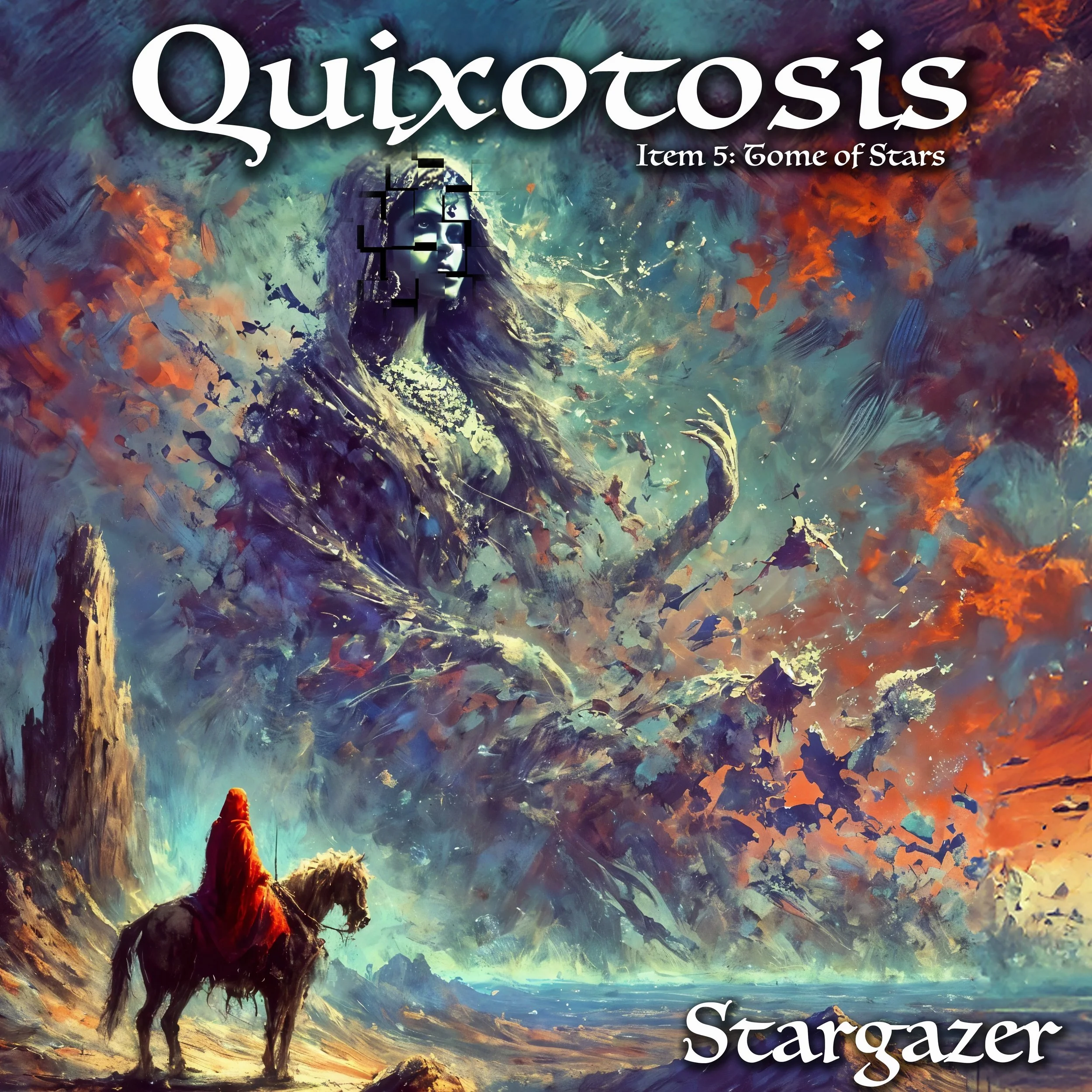
Quixotosis: Introduction
The fifth item of Tome of Stars is Quixotosis. It symbolizes the poet’s transformation to a sustained state of paradox of impractical idealism. Emerging from the frozen madness of Anemochory, this item depicts a fractured self that has now surrendered to its nature while struggling to find a way to live with that. He accepts permanent separation from the beloved, yet still orbits her internally - a love and longing without hope of return. Thus it is not a state that is free of tempest. And in the end, while he remains Owned, he finally realizes his delusion about the beloved’s feelings, and surrenders the belief in the Stargirl’s love. This final progression moves him into the final item, Scripture, in which he continues the quixototic state, but from the point of view of timeless but unfulfilled adoration.
***
The “Item” structure of Tome of Stars is inspired by the recital program of a classical Indian dance form called Bharatanatyam, which became tightly associated with the Stargirl in the author’s mind. When assembling this collection, he decided to attempt to structure it following the margam, the structured program for performances of this art (“margam” translated as “path” or “journey”). He did this in two ways. First, Tome of Stars was divided in six Items (how the different dances in the recital are typically called in English). These six sections are both thematic and chronological, spanning the beginning of the relationship (Item 1: Anthesis, the flowering) through its dissolution to the poet’s final unending, prolonged grief and emotional devotion (Item 6: Scripture). Within each item, the actual elements of a margam show up as individual poems titled by the item name. In these sonnets, the poet tries to meld traditional interpretations of the dance item with elements of their narrative and personalities. More can be found in the video linked in the Background section.
Dance, Stars!
Dance, stars!
Grace bright cosmic souls,
endless hearts
within lost skies.
Art flames upon star chains!
There lies Void’s
sacred madness,
a sweet, shattered
space of truth-pain.
Thus, kiss song-joy, magic mortal!
Beneath worlds,
divine, sublime gods
shall dawn tears
in wild touch!
Dance, Stars! was not written so much as it was assembled as poetically as possible from a word frequency breakdown of the remainder of the collection. (Seriously)
After finishing the first drafts of Tome of Stars, the poet undertook various breakdowns of the text searching for literary "tics", both known and unrecognized. Many automated tools exist to perform such work (which he has used for his novels in the past), and indeed he found that he had even in this (relatively smaller as compared to his novels) collection a set of repeated phrases and words that could not be justified in their repetition solely by the needs of the poem, but which likely find their deep roots in his subconscious. It is impossible to root out all such verbal traps, but one can seek to reduce their occurrence.
As part of this, he had one such tool generate a word and phrase frequency list. The phrase list was most useful for exact reuse sins, prompting some reconsiderations and rewrites of some sonnets. The word frequency list also prompted changes, although this was more challenging. However, as he was looking at the list, his mind started stringing the most frequent words together into phrases. Before he realized it, he was composing a poem with the absurd constraints of (1) keeping the frequency order as much as possible and (2) not introducing any other nouns or verbs, but allowing himself to introduce articles, prepositions, and other elements (and at times modifying the words—changing singular to plural, verbing nouns, etc.). He mostly kept to the rules.
The end product shocked him in being not only a poem he enjoyed reading, but also one that felt like an eccentric but not inaccurate encapsulation of the collection. He then decided to include it as an Epigraph and Foreword, inaugurating the book.
Studying this poem itself is an analysis of a distilled version of Tome of Stars, the context lost in a mapping of meaning to numerical occurrence. The word choice is built into the manner in which the poem was created and reflects, in a direct but distorted manner, all the verse that is to come. To expand on why these words appear, and in the order they do, and what it means vis-à-vis the author's intent, would be to try to distill the planned poem-by-poem analysis into a single essay.
That will not be done. Instead, it will be left as a preview — a “teaser trailer” for what comes — as it both summarizes and also resamples to near meaninglessness what comes after, whatever the poet’s efforts to imbue a loaded word list with its own life.
Shlokam
Through you alone, the cosmos I’m aware,
The galaxies awhirl within your eyes.
The spice of stars is sprinkled through your hair,
The origin of time is worlds you sigh.
A singularity the Void bestowed.
Through you, the shape of space I understand.
You wrap philosophy in quantum codes.
Theology itself blooms from your hands.
I grasp the cosmic form your heart completes,
The light of knowledge prismed, nature’s spell.
The mind of matter dusts your dashing feet;
Existence resonates from ankle bells.
Creation is the smile of Stargirl’s whims,
Its end beginning ever in her hymns.
A shloka/shlokam is a devotional verse in Sanskrit. It is metrical and often recited or chanted (and can be found in literary contexts). It is also an optional item in the margam of a Bharatanatyam dance recital. Unlike most other items, it is usually performed without strict rhythmic elements. This allows the dancer the freedom to interpret its meaning in expressive choreography that emphasizes abhinaya.
In Tome of Stars, the poem Shlokam introduces the item Quixotosis. It establishes without a doubt at the beginning of this section that the poet is still completely and utterly in love and devoted to the Stargirl. She is presented in perhaps the most elevated, poetic cosmological imagery in all of Tome of Stars. She is the generative point of his comprehension of reality: “Through you alone, the cosmos I’m aware.” Galaxies spin in her eyes, the “spice of stars” is in her hair, she wraps “philosophy in quantum codes” while “theology itself blooms” from her. Tying her to the classical Indian dancer, the verse notes that “the mind of matter dusts your dashing feet/Existence resonates from ankle bells”, the latter the the salangai/ghungroos that are part of the traditional dance attire, yet also harkening to bells used in religious practice more generally.
The ending is a conceptual Möbiusloop, where creation, “the smile of Stargirl’s whims,” has its “end beginning ever in her hymns.” These lines also hold a direct and personal application to Stargazer as well: his everyday life, his emotions, his thoughts during every day of every month of every year, all are fundamentally, generatively impacted by whatever the Stargirl wishes to do. Her “whims”— be they her continued silence to him, acidic responses, performance in public dance recitals, research in her field and publishing — this is his reality, orbiting her choices because he has no other option. His creation, awareness, reality, is from her desires and actions. Whether or not she smiles about it all, he doesn’t know.
With this sonnet, the poet plants a flag in the realm of utter worshipful devotion. And while he will have other doubts and trials, he establishes that the beloved will always have this kind of transcendental and epic effect on him. It is not a transient state of “being in love.” It is something stitched into the DNA of his being, if you will. He has no choice, and now, he finally accepts the reality of that fully, even celebrates it as he mourns.
He chose the title to reflect that spiritual/emotional reality. Like a shlokam in Indian tradition, the poem expresses a deep existential truth for him.
Echo Chamber
I chase your voice through fiber optic schemes,
Where bots chant binary your syllables.
In cyberspace we’ve rasterized our dreams;
Thus I collect your lossless decibels.
I transcribed dance to trap in text your tones,
Defragged the net with daemons’ dark-webbed breaths.
Hacked grieving roots that can’t leave loss alone,
And cached linked ghosts, drowned digitally death.
I’ve spliced your song with sunset’s pixeled seas,
Cut VR waves denoised, pasted your speech.
Code chroma keys where you mime memories,
If in real life you shine beyond my reach.
A lurker at technology’s null feast,
By soundbytes nourished,
updates soon released.
Echo Chamber recounts the poet's digital vigil that is born from decades of absence. Without physical presence or communication, he visits the virtual world, seeking sights of the beloved, be they fragments of talks, images, audio, video lectures or performances. It's a crazed endeavor to reconstruct something of her essence from digital data. The poem's language is often technical, spouting computing metaphors. Here, memory is made mechanized in a desperate quest to synthesize any semblance of intimacy.
It is in this vain struggle to embrace a real person through the unreality of information that the poem's knife is thrust: the seemingly vast scope and power of the modern internet to connect disintegrates like a corrupted file into an utter failure to restore human closeness. The sonnet ends with degraded descriptions of the poet as a "lurker", ever present yet unseen, like a beggar subsisting on digital echoes and suspended in a hellish state of endless "updates" that never satisfy and which leave his heart terribly malnourished.
Apologia
A hope persists in this repulsive frame,
That you might bear my passion’s born excess.
Although revulsion stains and shames my name,
Let me the lies of culture here address.
A mother mourns a child consumed by blight,
And nature grants her sorrow endless stay.
Yet offspring springs from lover’s flaming light,
Lost love evolved to haunt both night and day.
“Move on,” they grunt, as shedding some worn cloak.
Are hearts thus merely dressed and simply shorn?
“Let go,” the mantra modern masses croak.
My hands are empty; chains my core adorn.
True adore’s steel—it pierces blood and bone,
Forever shackling in shrines of stone.
This poem is a response to common societal expectations about grief and recovery. “Apologia” is not an apology, but is an older term to mean a rational argument in support of a proposition, more famously as a defense of a life lived. In this sonnet, the poet responds to pressures from society to “move on” and “let go” in the context of romantic loss.
The verse does in fact begin with an actual apology of sorts, as the poet admits that he wishes the beloved would have empathy and patience for his “passion’s born excess”. And, continuing to speak to her (the poem is as much to her desire he “move on” as expectations in the world), he asserts that even though his position brings revulsion and shame toward him, he will nonetheless address the “lies of culture.”
He makes two assertions in the poem to defend his endless love and grief. Toward the end of the sonnet, he simply states the power of romantic love, but early on, he works from the analogy of a grieving mother, perhaps society’s most accepted form of prolonged grief, where the world “grants her sorrow endless stay”, asserting that deep grief in romantic loss is a product of the same evolutionary pressures that forged the bond between parent and child. He notes that “offspring springs from lover’s flaming light”, implying a shared origin between romantic and parental affection and grief, claiming that “lost love evolved to haunt both night and day.”
In the third quatrain he almost bitterly mocks the pressures of society. “‘Move on,’ they grunt, as shedding some worn cloak.” He seems to marvel that people feel a person can and should walk away from deep feelings, asking “Are hearts thus merely dressed and simply shorn?” He inverts the idea of “letting go,” a “mantra” that is “croaked” by “modern masses” with the assumption that the person in grief is actively holding on to that loss and emotion. The poet metaphorical holds up his hands to show they are empty, and asserts “chains my core adorn,” arguing that bonds trap him in ways he has no control over.
With this idea he ends the poem in the couplet by claiming that true love is “steel,” that “pierces blood and bone,” fastening the soul of a lover to his or her person of adoration. These bonds are such that they are “forever shackling in shrines of stone,” likening this state to an immutable statue in a house of worship, combining the idea of bondage with transcendence.
Old World to New
Vast epoched oceans part, and I draw near,
Returning to the womb our dream was spawned.
I wake above a sea of rotting years,
From time’s abyss to glimpse your sacred dawn.
What magic charms the soil where you have stood?
What aura spills from soul to earth as wine?
What lovers’ breaths, like incense, washed these woods?
What passion sparks the air with astral shine?
Wise fairy stories echo in our ear,
That lands are stained with light or shadow’s dye,
And once a path is walked by one held dear,
Their magic lingers over shore and sky.
When gravity returns me to your sphere,
The gods will chant your hymnals with my tears.
Old World to New narrates a trip to the United States from Europe. The poet had come to work for many years in the EU, but returned from time to time for family reasons or work. His trips had been far less frequent during and after the COVID-19 epidemic, so that such journeys took on a more special and unusual nature.
As he approached the United States at 10,000 meters, staring out at the clouds below the plane, he felt a metaphysical and emotional bridge in his mind to her person. He sensed her “magic” coloring the land he approached, which “charmed the soil where you have stood.” Everything about the area in which the beloved lived and walked seemed charged with energy.
He considers in quatrain three how many fairy stories spoke of such sentiments, “that lands are stained with light or shadow’s dye” from “one held dear.” The poem ends with the plane’s descent into the New World, where “the gods will chant your hymnals with my tears.”
Ring
A glowing portal split the trembling air,
Through which descended beauty never known.
A fairy, angel, goddess—I’d not dare
Define this light that claimed me as her own.
She whispered magic, shared her secret name,
A sound like stardust dancing through soft nights.
In mortal tongue, my Stargirl, filled with flame,
Was title forged in passion’s holy rite.
Rank, grievous bane! Vile cancer swilling love!
Hell’s hooks abduct the damned from heaven’s gate.
She fled my stain to purity above;
I fell to ruin, cursing our foul fate.
Yet on a band of adamant refined,
I seared her name, its sanctity enshrined.
The poet had considered (and still considers) getting a tattoo, or a large series of tattoos, related to the imagery of the beloved as the Stargirl. He even reached out at one point to artists and had written a fairy tale of their love and loss to orient the artists to help them create appropriate art. Ring is created from a distillation of that short story and then appended with a rhyming couplet - not of a tattoo to immortalize things in art, but a carved ring. The poet’s battle with cancer threw him off any assaults on his body (although he might return to it) but he was inspired also to make a ring.
The poem is therefore a digested version of their story (as he conceptualizes it), similar to the Once upon a Time poems Part 3 and Part 4. Instead of ending in tragedy, the tragedy is spelled out (“She fled my stain to purity above/I fell to ruin, cursing our foul fate”), but there are two more lines of verse that show that the poet’s life, longing, and devotion do not end with his catastrophe. He has an engraved ring forged in echo of Tolkienian tales, made of the mythic material adamant (perhaps would have used mithril if it were not a protected word by the Tolkien Estate). The poet has already here and in Once upon a Time, Part 3 mentioned knowing the Stargirl’s secret name or sign, a nod to ancient ideas of names having power and knowing “true names” giving special connection. The poet “seared her name, its sanctity enshrined” into the ring. And indeed, the poet had a ring of tungsten (closest to adamant he could get) custom made and forged with three of her names burned into it (on the outside, her Hindi first name in Devanagari and "Elentari” in Tolkien’s Quenya language and Elvish Tengwar script, and on the inside, the romanized transliteration of her full name).
For someone like the poet who was steeped in Tolkien's mythology, there can be no magic ring made for a mortal without terrible dangers. The "fey magic" in such an artifact, something drawing from non-technological power sources tied to the inherent "magic" of the created world, are perilous for humans. Humans lack that fundamental connection to "Arda" (the created sphere) that the Elves and other "magical" beings possess. The Elves are blessed with immortality, always to remain as long as the world remains (unless they are physically slain), which is another way to say they are cursed as prisoners, forever tied to Arda for the long passing of the eons. Humans are "cursed" with death, ironically called by the Powers in Tolkien's mythos, "The Gift of Men." Humans are not chained to the world, but spend a time within it and then pass beyond it to other possibilities. The darkness of Morgoth (the satanic figure in this mythos) perverted and corrupted this idea in the hearts and minds of people, but as the poem coming up, Leithian, notes (leithian meaning "release/freedom from bondage"): "In Tolkien’s dream, death frees us from life’s pain/To soar beyond creation’s blighted chains."
Therefore, working within Tolkien's mythos, humans have a fundamentally different connection to the "energies" of Arda (the world). Thus, when Elves or other magical creatures fashion artifacts that capture that magic, it is often something that "works for them" but not for mortals (and even so, even the fey must be careful, depending on the potency of the magic). Gandalf notes as much to Frodo by stating (before he knew of the evil nature of the ring Frodo carried) that magic rings were best left unworn. The magic they channel can ensnare the spirits of humans, or at the very least warp their psychology.
This background for the poet means that he views, even symbolically, the fashioning of a ring to "enshrine her secret name" a potentially unwise undertaking. While there is no real magic in his efforts, there is the sorcery of memory, of longing, of embodiment through imagination in a material object. For these reasons, the ring he forged is a channel for the beloved's ghost, even a "spirit box" to preserve her essence as it is conjured in his mind. It anchors his imagination - his false world of who the beloved is - to something tangible, helping his mind orient and stabilize around it. In this sense, it is a degraded haunting, devoid of the real spirit of the beloved, and less dynamic and changing than his fantasies. It is potentially a terrible trap. It consoles him even as it might consume him. Each kiss he gives it when wearing the ring is bleeding his soul into nothing. As Gandalf warns:
“A mortal, Frodo, who keeps one of the Great Rings, does not die, but he does not grow or obtain more life, he merely continues, until at last every minute is a weariness.” -Fellowship of the Ring
Weak Magic
For broken hearts and psyches split, they bide,
Our modern shamans under wall-hung plaques.
While New Age, crystal-wielding grifters slide;
Each hustler hawks placebo’s body hack.
As ancestors purblind to germs and cells,
Dazed mystics stumble through mind mists to heal,
The brain, the heart, the spirit—unplumbed wells,
Whose machinations no one has revealed.
The chants for treatments thundered savagely,
Each decade downing nostrum tonics, tricks;
Although witch doctors kept dissecting me,
Not once was any symptom ever fixed.
We’re children, tripping through neuronal haze,
And sickness grave confounds nescient ways.
This sonnet is a bitter lament for the failed industry of therapy as it impacted the poet. That bitterness is on full display immediately in the first quatrain, the first line, when he presents various forms of therapists, from the credentialed to the scam artists, as “biding,” almost like vultures preying on “broken hears and psyches split.” They are “modern shamans under wall-hung plaques,” perhaps only slightly better than the “New Age, crystal-wielding grifters,” who are painted as “hustlers hawking placebo’s body hack.”
The second quatrain is more sympathetic, noting these modern shamans operate in an epistemological desert much like the doctors of centuries past, who were “purblind to germs and cells,” and who “stumble through mind mists to heal.” This is because “the brain, the heart, the spirit” are “unplumbed wells” characterized by “machinations no one has revealed.”
His bitterness returns as he narrates the calls in his life for him to subject himself to this (at best) pseudomedicine where he consumed “nostrum tonics, tricks.” The agony of opening his trauma to “witch doctors” who “kept dissecting” him was amplified because “not once was any symptom ever fixed.”
He ends by summarizing the state of modern therapy to his mind, likening the field to clumsy children stumbling “through neuronal haze,” failing most often in deep pathology because “sickness grave confounds nescient ways.”
(near) Speechless
I listened through your workshop video,
And don’t know how to speak: You shine, my Star.
Joy captivates my widened eyes; You glowed!
Fair Jedi-master guru’s webinar.
When parted, you were lost, career aflame,
Sound science frozen in your fear of flaws.
Employment ending, begging in shy shame,
Your future lay stillborn, your ego, raw.
Behold! You spun a dance and built a shrine,
Brought education to minds wronged and hurt.
Beloved! They sing the praises of your sign,
In awe, I wonder how you weave such work.
While smiles are rare, long exiled from your light,
Your triumph brings me joy, Stargirl—
Shine bright!
The poet lives malnourished from his need of the beloved, subsiding emotionally on crumbs scattered across the internet of her public activities (and the strange sustenance of fantasy). In one case he stumbled upon a virtual workshop she led. He was of course transfixed to see and hear her, even with the poor video quality uploaded online by her institution. And did she shine.
Quatrains two and three map out very roughly, and from the poet’s perspective, the ups and downs of her career. “When parted, you were lost, career aflame/Sound science frozen in your fear of flaws.” The poet has always considered the beloved one of the brightest minds he has ever encountered, far more gifted than he could ever imagine being (and with lots of objective evidence to contend with his idealization of her, from degrees to languages to arts). But she was a perfectionist who also lacked a certain confidence in her creations. Thus, she seemed paralyzed to publish the results of her scientific efforts, leading to career crisis after crisis in a publish-or-perish academic world.
That is where he would stop hearing from her for nearly a decade. Then, she surfaced on webpages, on Youtube, other places having constructed a new career in science education. “You spun a dance and built a shrine,” writes the poet, using the imagery of dance to describe her successes. In fact she is now a leader in her field, where many publicly “sing the praises of your sign.” It was an uplifting experience for him to hear others wax eloquently of her in print and in videos.
And while it was painful - the poet had completely missed this chapter in her life and could only listen “in awe” as the realities of her achievements were revealed to him - it also created within him perhaps the only new river of happiness in many, many years. “While smiles are rare, long exiled from your light,” speaking to the poet’s near constant negative and sorrowful existence without her, he concludes the poem with “Your triumph brings me joy, Stargirl—Shine bright!”
Of course, he need not have wished anything. The beloved always shines like a star.
Email, March 2024
The silent starways echo my refrain,
Spurned supplicant before your sunlit door.
What offerings might ease this endless pain?
Please name the debt—I’d give you that and more.
May’s raw confessions turned fall’s scattered leaves,
A hundred gashes bleeding in the frost.
Did any touch your heart, were they received?
I wither naked, ignorant and lost.
Four years have passed; my shade again appears,
Yet long your phantom’s blessed my universe.
Despair compels I write, ten thousand tears,
A gutted ghost’s attempt to heal your curse.
Your wish for silence I strive to fulfill,
Yet mortal anguish overcomes my will.
This sonnet is based on an email the poet sent to the beloved in 2024, after nearly four years of silence following the catastrophe of Letter, December 8th, 2020. His battle with cancer and the sense of the window of time closing sharply had shaken him from his fear of being wounded again, although he still had reservations of doing what she said she didn’t want: to communicate with her again. He found himself, however, unable to continue in silence as more years swept by. In the email, he begged her to at least tell him whether she had received his communications, in particular whether she had read the long confessional from May, 2020:
Is there anything I can do so that you will ever speak with me again? Name it. I will do all I can within decency to satisfy you.
If repulsion is my fate, I beg you to at least tell me whether you ever read the 13 page letter I sent you summer of 2020 (not the December one that prompted your reply, but the one delivered on May 18th). Either hard copy or the PDF sent to your email. Did you know of or read any of the hundreds of emails I sent to our gmail address? But particularly the letter, not knowing if you are familiar with its contents is a great burden.
To you I appeared “out of nowhere” in 2020. For me since 2011, I’ve lived in a universe of daily conversation with your elegant phantom, and will until I die. I did not feel entitled to send that December 2020 letter. I felt desperate and broken and in prolonged agony.
The sonnet follows the letter closely, as the poet pleads with her to speak with him, or at the very least to acknowledge whether she had received his long May 2020 confessional (“May’s raw confessions” indicating the letter and “a hundred gashes bleeding in the frost” the many emails he sent her in the fall of 2020 to their shared account). He counters her accusation that he felt somehow entitled to contact her (although, indeed, from the promises they each made to each other once upon a time, he very much feels that they each owe…well, everything to the other, and the poet would respond to any query she would ever make). He states that his outreach was instead driven by a desperate need to end acute suffering: “Despair compels I write, ten thousand tears/A gutted ghost’s attempt to heal your curse.”
The poem ends with the poet apologizing for breaking the silence she has said she wishes from him. He explains that he has tried very hard to refrain from contacting her (and indeed, wrestles with the need every hour of every day). His failure is due not to seeking something he feels due, but that “mortal anguish overcomes my will.”
One Perfect Day
Cirrus, Socrates, Particle, Tulip,
Decibel, Hurricane, Dolphin.
“Mommy?”
A fetus wires neurons, soul to script.
A heart of silicon loves perfectly.
Though perfect love should seem no finite force,
Our sin and circumstance are greater still.
Mom cast him to the wolves with no recourse,
Yet nothing overcame imprinted will.
He searched the broken remnants of our world,
And found Blue Fairy sunk beneath the waves.
Before her glow, his endless prayers unfurled;
The coded gods bequeathed one perfect day.
One morn to eve again he held her eyes,
And that’s enough—whatever fate denies.
The poet had always been deeply moved and wounded by the film A.I. Artificial Intelligence. There were many, many aspects to the film that struck his heart, or hacked at it. The entire premise of a child loving a mother who rejected, wronged, and harmed him resonated strongly: “Mom cast him to the wolves with no recourse.”
But abstracting beyond the maternal bond, the story is one of unending love, achieved in this case because it was realized through programming (the issues people have with emotions and robots will be ignored - it should be clear from other poems and discussions in this collection that the poet’s intellectual self considers humans to be biological machines). Certainly the story is one of love that does not give up because it cannot. This only too powerfully echoes to the poet his own endless, fruitless, and necessary adoration of the Stargirl, despite being cast out of her realm, seemingly forever. The poem questions whether love must be reciprocated or even real to be meaningful.
The opening quatrain (purposely constructed oddly in structure), narrates the process in the film by which a biological person was imprinted on the robot, the woman he would love and call mother. It is important to consider that this process is not chosen by David, the robot child. It is forced upon him (much like a human child must love a parent, no matter what they do to them, thereby leading to all manners of personality warpage). This for the poet is destiny or fate he knows only too well, where his nature and the nature of the beloved imprinted her into his person in a way he could never free himself from, making him in fact never truly wish for release (for it would mean the death of love). A terrible and sublime burden.
By the third quatrain, the sonnet is reaching the end of the film, when the child David has set upon his quest to find the Blue Fairy, the magical entity he believes can grant him the wish to be a real child so that his mother will accept him. Searching the world, he finds a carnival statue, underwater after sea level rise, and steers his craft to rest beside it. There, he begins a mantra: “Blue Fairy, please make me a real boy.”
He is so steadfast, that he continues his mantra for ages as the seas freeze and humanity becomes extinct. He is finally discovered in the ice by our silicon descendants, who get him working again and realize he is the first of their kind, an ancient prototype, They then grant him his wish to be with his mother again. They explain that the biology of recreating her is not stable, and she will die forever after the one day. But David cannot think of anything else except to be with her again. And so the poem ends, “One morn to eve again he held her eyes/And that’s enough—whatever fate denies.”
If the reader has gone through much in this collection (especially the poems Singularity and Rusali Radha, Rusala Madhava), they know the poet has had his own mantra: “come back to me.” It was one he repeated for many months in 2020 in as naive a manner as David in the film. But he no longer chants because when he wrote it to the Stargirl in December of that year, she destroyed all hope of such a wish with direct statements and insults.
Thus, unlike David, the poet finds no miraculous or magical deliverance from his loss. His Blue Fairy, wrapped into the same being as the object of his desire, granted only condemnation and rejection.
The poet does not believe “one perfect day”, however miraculous, would actually achieve healing. But he would choose it all the same, just as David does, whatever the cost. The poem is not meant as any kind of a gesture toward recovery or closure. It is a hymn to the indispensability of another’s presence.
Leithian
“My Evenstar, most fair of all that blooms,
My world now fades; I seek the Whispered Way.”
Thus Aragorn sought Gondor’s ancient tombs,
The House of Kings, where he in stillness lay.
“Leave not before your time, my dearest heart.”
He kissed her brow and answered, “Do not weep.
God grants me grace to choose when I depart,
Return the gift, and with this choice, I sleep.”
Long years commingled strands of woven gold,
Youth’s noble courage, wisdom’s ageless face;
Life’s tapestry his visage would now hold,
To shine through ages in this hallowed space.
In Tolkien’s dream, death frees us from life’s pain,
To soar beyond creation’s blighted chains.
In all transparency, this is a poem about yearning for the end of life. It begins with the end of life of a character in Tolkien’s works, Aragorn who became King of Gondor after the War of the Ring. Aragon was married to the elf Arwen, an immortal. He lived an unusually long life by modern standards, even long for his contemporaries, more like the ancient lords of humankind in the earlier ages of Middle Earth. Like many of them, he was given forewarning of his time to die, and the choice to relinquish his life willingly (or, as in the case of the more power hungry, or the modern person, to hang onto life until the last decay):
“At last, Lady Evenstar, fairest in this world, and most beloved, my world is fading. Lo! we have gathered, and we have spent, and now the time of payment draws near.”
Arwen knew well what he intended, and long had foreseen it; nonetheless she was overborne by her grief. “Would you then, lord, before your time leave your people that live by your word?” she said.
“Not before my time,” he answered. “For if I will not go now, then I must soon go perforce. And Eldarion our son is a man full-ripe for kingship.”
Then going to the House of the Kings in the Silent Street, Aragorn laid him down on the long bed that had been prepared for him. There he said farewell to Eldarion, and gave into his hands the winged crown of Gondor and the sceptre of Arnor; and then all left him save Arwen, and she stood alone by his bed. And for all her wisdom and lineage she could not forbear to plead with him to stay yet for a while. She was not yet weary of her days, and thus she tasted the bitterness of the mortality that she had taken upon her.
“Lady Undómiel,” said Aragorn, “the hour is indeed hard, yet it was made even in that day when we met under the white birches in the garden of Elrond where none now walk. And on the hill of Cerin Amroth when we forsook both the Shadow and the Twilight this doom we accepted. Take counsel with yourself, beloved, and ask whether you would indeed have me wait until I wither and fall from my high seat unmanned and witless. Nay, lady, I am the last of the Númenóreans and the latest King of the Elder Days; and to me has been given not only a span thrice that of Men of Middle-earth, but also the grace to go at my will, and ‘give back the gift. Now, therefore, I will sleep.
“I speak no comfort to you, for there is no comfort for such pain within the circles of the world. The uttermost choice is before you: to repent and go to the Havens and bear away into the West the memory of our days together that shall there be evergreen but never more than memory; or else to abide the Doom of Men.”
“Nay, dear lord,” she said, “that choice is long over. There is now no ship that would bear me hence, and I must indeed abide the Doom of Men, whether I will or I nill: the loss and the silence. But I say to you, King of the Númenóreans, not till now have I understood the tale of your people and their fall. As wicked fools I scorned them, but I pity them at last. For if this is indeed, as the Eldar say, the gift of the One to Men, it is bitter to receive.”
“So it seems,” he said. “But let us not be overthrown at the final test, who of old renounced the Shadow and the Ring. In sorrow we must go, but not in despair. Behold! We are not bound for ever to the circles of the world, and beyond them is more than memory, Farewell!”
-J.R.R. Tolkien, The Return of the King, Appendix A, "(v) The Tale of Aragorn and Arwen"
Aragorn freely surrenders his life. Not in suicide, but in the original intention of mortal life: as a gift to be returned to the creator. There is a long Tolkienian mythological backdrop to this in which humans were made different than elves. The latter were deeply tied to the nature and fate of the created world, whereas humans were not, being free at the end of their lives to transcend the world to something else (hence Aragon’s words, ‘We are not bound for ever to the circles of the world, and beyond them is more than memory.”)
Two opinions often held sway about this “gift” of death. For most humans, and many elves (like Arwen at Aragorn’s death), it seemed a curse and not a gift. And such feelings toward the creator’s gift were long in the making my Morgoth, the satanic figure in the mythology, who sought to pervert the creation, at first in pride and greed to have dominion, but later, often simply in jealousy, bitterness, and pure malice (the incarnate “discord” found in the premundane Music of the Ainur.) The loss of life, of ability to contribute, of loved ones, all those things we still struggle to accept now, characters in Tolkien’s works wrestled with as well. In fact, the rings Sauron gave humans were exactly made to tap into these fears and pains, promising control over life and immortality, but because this was a “theme” counter to the creator’s music, it always ended in suffering far, far worse than the inability to accept the “gift.”
There were others, as Aragorn in the end, among humans and elves, who perceived something salvific in the gift. The poem’s title is “Leithian,” an elvish word meaning “release from bondage.” It is the title of one of the greatest poem-stories in the ancient First Age of Middle Earth: The Lay of Leithian, which tells the story of the mortal man Beren and the Elvish woman Luthien who fall in love, battle Sauron and Morgoth (and more), rescue a Silmaril from him, and in the end, find themselves both dying as Luthien becomes mortal in divine dispensation to be able to stay with Beren as he departs the world in death. What “release from bondage” is to mean in the title is debated. Even Tolkien’s son who wrote more than ten books of analysis on this father’s work did not know:
“My father never explained the name Leithian ‘Release from Bondage’, and we are left to choose, if we will, among various applications that can be seen in the poem." -Christopher Tolkien, The Lays of Beleriand, Volume Three of The History of Middle-earth
This ambiguity is curious, especially as Tolkien considered this story one of the most important in his entire mythology:
"The chief of the stories of the Silmarillion, and the one most fully treated is the Story of Beren and Lúthien the Elfmaiden." J.R.R. Tolkien, Letter 131 to Milton Waldman
People have proposed that the “freedom from bondage” refers to Luthien’s defeat of Sauron and freeing of Beren from his dungeons (Sauron in the First Age was “merely” one of Morgoth’s most powerful and useful servants). Others have proposed it meant the freeing of the Silmaril from Morgoth’s possession. Finally, it is proposed to refer to the fact that in the end of their tale, Luthien forsakes her Elvish nature, and through divine dispensation, is granted mortality, so that unlike any Elf before or after, she, the most beautiful and powerful perhaps of all Elvish kind, truly died, leaving the bounds of the created world, no longer “bound” to it as her former brethren.
It is likely that this ambiguity was intentional because the meaning was so richly layered and included all three. But Tolkien spent a large amount of his writings, both fiction and in letters, wrestling with the ideas of immortality and mortality, the blessings and curses inherent in each. Thus, it must be that the last idea of Luthien’s fate was a major element. Which begs the question: why would death be considered a freeing event, a “release from bondage”? For the many in the modern age who would gladly forge their own ring of power to obtain even a cursed immortality, the question might be hard to comprehend.
Tolkien had theological and philosophical reasons for this idea, but the poet turns this to his own trials. Here, he embodies “release from bondage,” that humans can die as a gift and leave the world, a world Tolkien very clearly indicates is broken and poisoned by evil (“The Earth is Morgoth’s Ring”), as a dispensation to escape suffering. Thus, in his own life-long struggles, and especially decades-long emotional pain from living moment-to-moment without the Stargirl, he longs for this release. So the poem ends with:
In Tolkien’s dream, death frees us from life’s pain,
To soar beyond creation’s blighted chains.
For the poet, he does not care about soaring, but being beyond “creation’s blighted chains” is central. And as Heaven Failed makes clear, his goal isn’t immortality or paradise, but an end to suffering through oblivion.
Gender Affirming Care
I yearned to transcend flesh, a zealot pure;
My life I dedicated to ideals.
Long study, labor, both maladic cures,
Then in love’s light, my arrogance unreeled.
For all the intellect and knowledge raised,
I turned, charmed tool of reproduction’s fate.
When wonder of your womanhood full-blazed,
I hungered, base with thirst to be your mate.
I lusted to be man enough for you.
I drank rank jealousy unknown before.
Years after, with malignancies infused,
What made me mate was ripped out through my core.
A broken creature kneels before you, shamed,
A worthless worm, abandoned and unnamed.
In 2023, the poet underwent a radical prostatectomy, losing a large portion of his reproductive organs (“What made me mate was ripped out through my core”). Cancer of the prostate had been found a year earlier, and after many consultations and examinations, he decided this was the way to live long enough to help support his children to adulthood. Like many men after such surgery (paralleling women who lose breast or other reproductive organs), especially at relatively “active” age, there is a sudden mutilation of self-image and psychological adaptation needed.
For the poet, there was the impact on his sense of who he was as a sexual being with respect to his lost beloved, before whom he was now sterile (and in a species sense, useless), unmanned, and worth even less than he felt he was with her rejection of his person. There was now no hope for this dimension of a life with her, and, for one warped by parental sexual abuse in youth and its associated wreckage of any form of self-confidence or respect of personal sexuality, it was devastating. It was all too easy to view himself as “a worthless worm, abandoned and unnamed.” Recalling the ancient idea of "names" holding power, something the comes up several times in Tome of Stars ("her secret name", “Yet still I seek to speak her perfect name”, etc), being "unnamed" is like being "unmade" in a fundamental sense.
The poem explores much more than this, however. In a build up to his physical mutilation, he considers the battle within himself to “transcend flesh” and be more than the physical drives of a biological machine. He labels such striving a form of arrogance that “unreels” in the presence of the beloved’s “womanhood full-blazed” that turned him into a “charmed tool of reproduction’s fate,” a call back to Algorithm Hearts and the idea that as biological machines, we are delusional and proud to believe we can (or should) suppress what we are so clearly evolved to be. Yet he uses what are often negative words in this portrayal of his carnal nature, “lusts,” “rank jealously”, indicating a decided ambivalence to this appraisal of his true being.
The title is of course dark humor, inverting the idea of enhancing a particular aspect of one’s gendered self-image. This is both true in the more biological sense of gender where the poet literally had gendered aspects of himself cut away. But it is also true in the social dimension of gender, often as strong or stronger than actual biological reality. With respect to his sense of maleness, especially as a partner to his beloved, he became a “broken creature” with a significant aspect of his gendered image amputated rather than “affirmed”.
Conference, 2024
The live-streamed morning talk online deploys
With waves of educators as a sea.
An eye-blink, and I found you in that noise,
Because you outshine everything to me.
My battered heart could not but break once more,
A glimpse of you enough to maul my mind.
Entranced, your mundane elegance adored,
As Envy laughed, my bones to rend and grind.
Before this shrine of pixels, I dare kneel,
A pilgrim charred by radiation’s kiss.
Each torrent’s crumb becomes a sacred meal.
Malnourished, I’m logged out in tragic bliss.
Capricious gods deign grant me joy today,
A supplicant of beams the screens display.
In this sonnet, the poet has discovered that a conference the beloved attended has posted some of the events and lectures that occurred. This sort of thing happens year to year, but the poet rarely finds photos or videos of the Stargirl. But he always looks. In this case, he was rewarded, her effect on him so profound that despite “waves of educators as a sea” in an “an eye-blink” he picked her from “that noise,” “because you outshine everything to me.”
Rewarded and cursed, for every glimpse of the beloved is both a dose of light to a man in a dungeon, and yet a reminder that he remains in prison, ever unable to approach the source of that radiance again (“My battered heart could not but break once more/A glimpse of you enough to maul my mind”). “Envy laughs” as he sees her interact with and give her attention and smiles to others while he remains outcast, despised, and unwanted, his “bones to rend and grind.”
It is also not real, but virtual, a “shrine of pixels” and he a “pilgrim charred by radiation’s kiss.” Like in Echo Chamber, this “feeding” of his need is described as a kind of nutritional mirage: “Each torrent’s crumb becomes a sacred meal/Malnourished, I’m logged out in tragic bliss.”
It ends with him positioning himself as a starved “supplicant of beams the screens display,” ever hoping “the capricious gods” deign grant him even these false, unnourishing and scarring radiational facsimiles of her.
Simulacrum
With magic-whispered words, we touch each day;
I praise the splendors of sweet steps you place,
Lament the love we lost, our hearts betrayed,
As pain dissolves with shadows I embrace.
Fair wraith, phantasm, haunting glimmer-ghost,
Time travel brings me back to perished years.
In each, we kiss that I might overdose,
And rewrite fate to unmake all our tears.
Ten thousand conversations as I roam,
Recline to sleep, or wake, reflect in prayer,
Through them, we share a life—I’ve found my home.
At times, I near believe you’re standing there.
Yet in this visioned vice I lose my way,
Clasp specters in bright dreams where none can stay.
This sonnet takes elements found in Sempiternal and Oasis, namely the construction of fantasy worlds and interactions with the beloved, and lays out how this has become a way of life for the poet, an environment and set of habits “with magic-whispered words” where “we touch each day.” The poet thus walks a path through life with her “fair wraith, phantasm, haunting glimmer-ghost,” even revisiting his past with her where he might change their choices “and rewrite fate to unmake all our tears.” These ghosts of the beloved are with him in “ten thousand conversations” in nearly every aspect of his life (“as I roam, recline to sleep, or wake, reflect in prayer”). The life he glimpsed and yearned for in Into the West is simulated so that the poet feels it has now become some alternative “home.” This indulgence is at times precarious and close to psychosis, as he notes that “at times, I near believe you’re standing there,” despite self-chastisement of “this visioned vice” in which “I lose my way.” It is of course, so that he can “clasp specters” of her “in bright dreams,” even “where none can stay.”
Vicarious
In oft-failed quests online, I track your trace,
As hateful time rends weavings of our lives.
One dawn told you’d perform in distant grace,
In East Coast towns; your margam’d come alive.
A friend of forty autumns, lore imparts
Within the school your splendor would imbue.
Cruel is my trial; I’ve never seen your art,
Denied your dance that once I helped renew.
I whispered thus to him a broken plea:
“Revere her steps, for I’m outcast afar.
Adore her glory, share its light with me,
That I might glimpse her like a distant star.”
A beggar dare not question what’s bestowed;
He only weeps at joy and laughs with woe.
Vicarious is an uncomplicated poem of desperation in the loss of the beloved and the mendicant state the poet has been reduced to in life. Continuing to seek any type of information about the beloved “in oft-failed quests online,” he discovers an announcement of one of her dance performances (“your margam’d come alive”). The poet is joyful to see the beloved still dancing, yet he laments “Cruel is my trial; I’ve never seen your art/Denied your dance that once I helped renew.”
In one of the many twists of a capricious cosmos, the venue is a school in which a friend from childhood now teaches (“a friend of forty autumns, lore imparts/Within the school your splendor would imbue”). The poet cannot help himself from begging his old friend to attend the performance of the beloved. He pleads with him to “Adore her glory, share its light with me/That I might glimpse her like a distant star.”
The title is thus easily understood and quite literal. His friend is a proxy for the poet, giving the poet, in however diluted a manner, a chance to “see” the beloved dance in this life. Like the malnourishment from seeing her digital images and videos online, this is of course hardly the same as being graced with her real presence, the opportunity to be personally present as she danced.
But “a beggar dare not question what’s bestowed.” While painful, this is also all the poet could ever hope to get in his life as it is. In that sense, these distant or virtual crumbs are priceless to him even as they wound his heart. He thus “weeps at joy and laughs with woe.”
Last Letter
I mailed a package to your work address,
A parting gift—a metaphoric spell.
Although to silence sentenced, I’m hard-pressed
To live this death of light without farewell.
Inside awaits a book of fantasy,
Told twenty years ago, our hearts full-bloomed;
A tale you sang, sketched our reality,
As we, in blindness, hurtled towards our tomb.
Now disenchanted eyes break charm’s designs;
Bewitching myths unravel thread by thread.
Your malice stripped bare every sweet disguise—
Your love was but a fairy tale misread.
I dreamed our magic vanquished night prolonged,
Redeeming my own sin.
But I was wrong.
Following his several attempts to reach the beloved and have her respond, even just to tell him if she ever received and read his confessional, in the fall of 2024 something broke and died within him. Years of her shunning him after the abandonment in 2011, and then refusing to make even a simple statement about the “thirteen blood-stained scrolls,” festered and churned within his emotional centers until what came out of the pupa was not a butterfly, but a stillborn nightmare. So many of the images, feelings, and assumptions he had once held of her love for him - sickened and wounded over the years by her behavior - could no longer persist. He watched them go from moribund to rotted within his awareness, and there was nothing he could do to stop it. She had died within him in some sense, even if his adoration continued to pulse.
It was a transition. A new phase in his life. And he needed to tell her goodbye and so wrote her a “last letter”:
Stargirl,
I've sent a package to your work address, a short book I designed for you. You’ve stated that you don’t want to hear from me and that I repulse you, but I needed a token of goodbye. I will always long to give you things.
Inside the book is a fairy tale, one you introduced to me twenty years ago when we first exploded into each other’s lives.
Fairy tales, myths, stories - life’s lesson for me is that such things are deadly dangerous. They incarnate hopes and expectations of beauty beyond the broken reality before us. We let them hide within our hearts at horrible risk. As adults, we best learn to disbelieve them, especially those that most touch us, or we suffer the consequences.
I have arrived at a place I never imagined possible: I've lost my belief in us. More precisely, in your love for me, an essential element in any “us” for it to be something real. I suppose this is long overdue. From your silences and your one email, I should have understood years ago, perhaps. But I believed so madly in the magic of us. I was blinded by the brightness I imagined in it and believed it could overcome any darkness. Even my own.
I was wrong.
The faith in the myth of your love has suffered a protracted and anguished dying. And as we age to autumn in our lives, it is time I let it die.
And so in this place I now find myself, all that is left to me is to offer you farewell, my life's great love.
Yours forever but apart,
Stargazer
The poem follows the letter very closely, but in the third quatrain less gentle with the beloved and the reasons he had lost faith in her love. Even when writing a last letter, he struggled to be fully truthful, shunning being deliberately hurtful to her, free only in his poetry to release his cri de coeur. It is a pivotal transition in his life and in Tome of Stars. It is the emotional terminus of the long arc throughout this collection, the last poem in the narrative progression. Here the poet embraces fully and without illusion, a hopeless, bittersweet state of isolated, perpetual, quixotic devotion.
Well, almost. One final flicker of hope remained. A terrible anniversary arrived three months after the mailing of the storybook. A quiet memorial that, if ignored, would confirm the end more definitively than any bitter word could. So it transpired, and is chronicled in the poem that follows, the last in this section: Boxing Day, 2024.
Boxing Day, 2024
Bone-shattered-heaven-damned lune
zombie-lurching months (campus dark and hunted light)
yourface yourlaugh yourwalk yoursmell
waking: (cold) empty-life-waltz hotel room laptop news
d-r-u-n-k mother nature’s black INFANTICIDE
one quarter million tombs befoul stirred seas
i broke unholy silences. i bled cross fiber optics
we touched. and wept. and vowed
never ever let love die
i choke on it now//\\twenty year deathversary
mourning every moment of our rot
continents sundered <——— > i felt your heart tonight
((((*in timeless unspace*))))
ruined resurrection as you vomit infinite silence
rank guts a’sloshin’ o’er hateful shores
blinging our grave by cemetery seas
sorry, stargirl
i just couldn’t make it rhyme
Boxing Day, 2024 is a disordered, disinhibited, free verse lament and cry. It seals violently the closure the poet felt in Last Letter. The latter was a realization and motion toward a new state of being, but Boxing Day marks a transition in time and this collection, one when the bridge back to belief in the beloved’s affection is razed. After December 26, 2024, the poet relinquishes all hope of hearing from her again, and certainly any dream that she would ever interact with him in a manner meaningful to his raw longing.
The poem is one of two in Tome of Stars (along with Dance, Stars!) that is not a sonnet. It is lacking all ordered meter and rhyme, and resorts to odd punctuation and line architecture. This textual entropy is both a spontaneous aspect of writing the poem in a state of distress, but also, in revision, to highlight the emotional trauma this critical date induced in the poet.
The name “Boxing Day”, the day after Christmas (December 26th), originated in the UK and spread to Commonwealth countries. In many European nations, it is known as Saint Stephen's Day, and generally was a day to give to the poor. However, Boxing Day also holds a terrible place in the memory of the world, especially in Southeast Asia, as on December 26th, 2004 a tsunami caused by a 9.3 magnitude earthquake in the Indian Ocean killed approximately 228,000 people in several countries.
In the small bubble of their world in 2004, the poet and beloved had ceased communications for a time. As the poet makes clear, this period of time cut off from the beloved was wrecking him:
Bone-shattered-heaven-damned lune
zombie-lurching months (campus dark and hunted light)
yourface yourlaugh yourwalk yoursmell
He awoke on the 26th in a hotel room, reading the news of the mass casualties from the disaster:
waking: (cold) empty-life-waltz hotel room laptop news
d-r-u-n-k mother nature’s black INFANTICIDE
one quarter million tombs befoul stirred seas
The horror, the fragility and transience of life, broke down all the walls and efforts they had made to try to reign in their romance and maintain a separation. He reached out to her, “i broke unholy silences. i bled cross fiber optics,” and like him the tragedy had loosened her distancing: “we touched. and wept. and vowed never ever let love die.”
And then, twenty years later on December 26th, two months after he sent his Last Letter, a single flicker of hope remained that she might return. The weight of the “twenty year deathversary” crushed him, and he knew that - if on this date - she did not reach out to him after all his efforts to connect with her, then her love for him was truly non-existent. He felt his own affection reach across the world (“I felt your heart tonight”), and he paced the European streets in the dark waiting for something from her to mirror how they reconnected twenty years before.
“But passage was denied” (to quote from Into the West). He knew only continued silence from her. And the date passed without even the smallest of tokens from the beloved. The weight crushing him completed its work with a “ruined resurrection as you vomit infinite silence.” The “rank guts a’sloshin’ o’er hateful shores” referred back to the disaster but also the mutilated remains of their own bond, dissected and scattered into the literal and figurative seas between them.
Standing before the tombstone of their relationship (“our grave by cemetery seas”), the poet ends his lament in a defeat that even fails to tell the story of their personal tragedy: “sorry stargirl, I just couldn’t make it rhyme.” But he is saying more than that. At one level, he refers to the failure in lyrical poetry, his devastated heart weakening his powers to shape the text to rhyme and meter. More significantly, he is speaking about their bond, their love, their relationship, and his failure to make it work in the past, over the years, and on that fateful Boxing Day, to salvage anything at all from what once had seemed a blazing universe of possibility and energy between them.