Index for Scripture:
Item 6 of Tome Of Stars
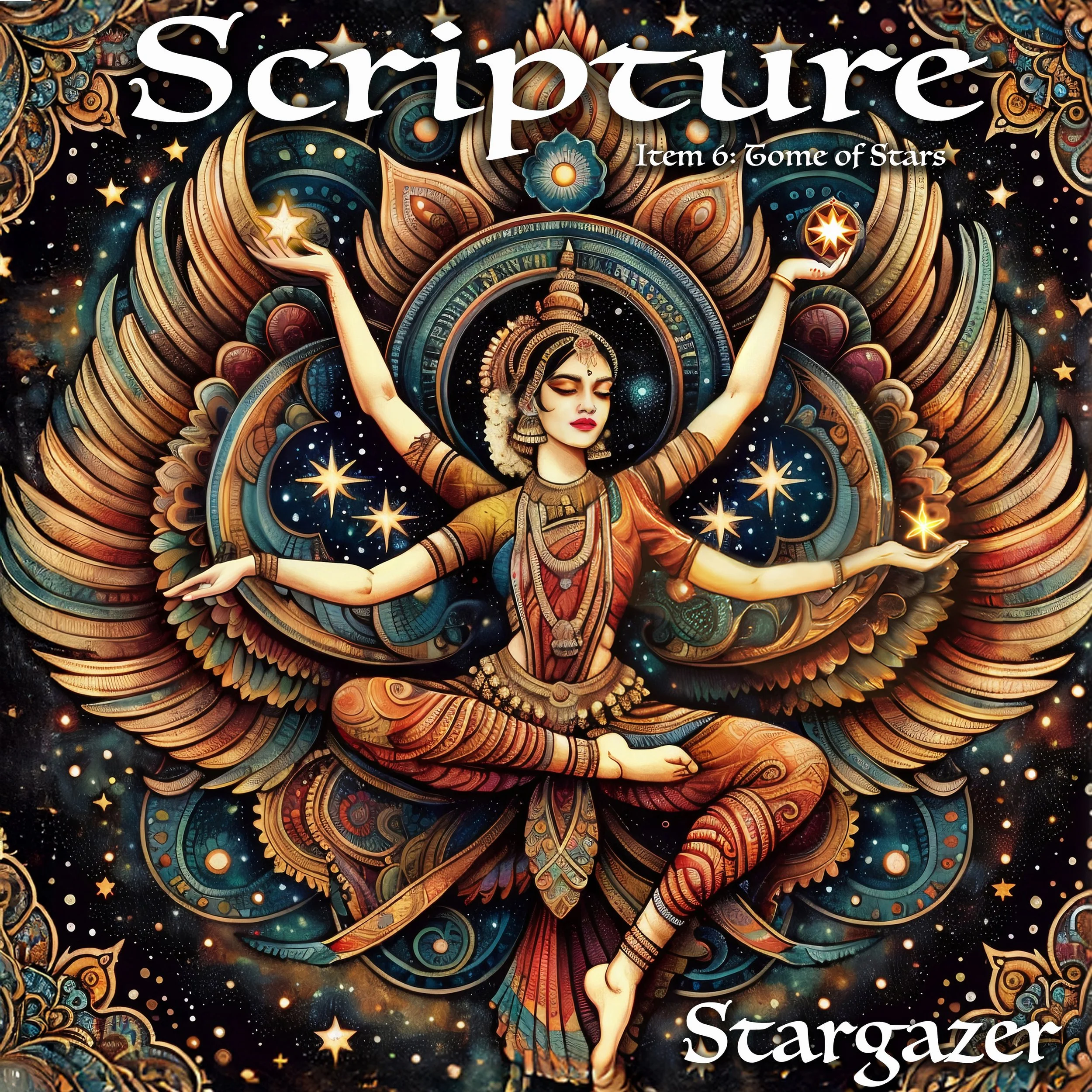
Scripture: Introduction
The final Item of Tome of Stars is Scripture. Here, the narrative arc is abandoned and instead what is presented is a steady-state consecration of the poet’s unrequited love. Quixotosis is transformed into liturgy.
In the early stages of conceptualizing Tome of Stars, Scripture (then titled simple “Prologue”) was intended as a quirky prose introduction to this book of poems, written from the perspective of a devotee of a cult of the Stargirl. In language appropriate for such a religious acolyte, this devotee describes the cult's mythology, his personal mystical encounter with the Stargirl, and the aftermath of how it shaped his life.
Of course, this is working at a second level beyond the superficial vehicle of this personal spiritual narrative. The man is clearly more generally a proxy for the poet, his religious devotion a metaphor for the poet's emotional commitment, and the religious experience of encountering this cosmic force, both the heaven of it and the hell of losing it, is directly reflective of the poet's personal emotional journey and the transformative impact of the beloved on his life.
At some point, the poet became dissatisfied with the prose aspect and felt it did not harmonize well with the rest of the collection of sonnets. He then took this many-paged revelatory testament and transformed it into a set of poems, still placed at the beginning of the poetry collection and titled Synopsis. More than half a year after this as he filled in the poetry of the collection, this section's placement bothered him. The tone and perspective was very abstract, elevated, worshipful, and summarized the entire love-to-loss narrative (albeit in a symbolic manner), and he felt the reader would be distanced from the personal story in the book when placed so early, before the story itself could be told.
He then moved this entire set of nine poems to the end of the book, opening Tome of Stars with Anthesis, the blossoming springtime of the romance. It was still called Synopsis at the end, but as the other items in the book developed, the transition from Quixotosis to the last poems finally struck the poet as a liturgical transformation of unrequited love, a ritual needed to express devotion when the object of adoration was not present and was expected not to be. And Synopsis sounded bureaucratic and boring anyway, and so he renamed it Scripture.
He placed the final poem Uni Verse after Scripture, as a coda to the entire work, not as an element of the sixth item. Uni Verse is a “meta” poem, retrospectively looking back on the poems that came before, commenting on them, and speaking directly to the reader to break the fourth wall. Its tone and perspective are very different from the poems in Scripture, and represent the side of the poet that still can look at the mess that he is, mock it some, and yet fully accept that this is his nature.
***
The “Item” structure of Tome of Stars is inspired by the recital program of a classical Indian dance form called Bharatanatyam, which became tightly associated with the Stargirl in the author’s mind. When assembling this collection, he decided to attempt to structure it following the margam, the structured program for performances of this art (“margam” translated as “path” or “journey”). He did this in two ways. First, Tome of Stars was divided in six Items (how the different dances in the recital are typically called in English). These six sections are both thematic and chronological, spanning the beginning of the relationship (Item 1: Anthesis, the flowering) through its dissolution to the poet’s final unending, prolonged grief and emotional devotion (Item 6: Scripture). Within each item, the actual elements of a margam show up as individual poems titled by the item name. In these sonnets, the poet tries to meld traditional interpretations of the dance item with elements of their narrative and personalities. More can be found in the video linked in the Background section.
Dance, Stars!
Dance, stars!
Grace bright cosmic souls,
endless hearts
within lost skies.
Art flames upon star chains!
There lies Void’s
sacred madness,
a sweet, shattered
space of truth-pain.
Thus, kiss song-joy, magic mortal!
Beneath worlds,
divine, sublime gods
shall dawn tears
in wild touch!
Dance, Stars! was not written so much as it was assembled as poetically as possible from a word frequency breakdown of the remainder of the collection. (Seriously)
After finishing the first drafts of Tome of Stars, the poet undertook various breakdowns of the text searching for literary "tics", both known and unrecognized. Many automated tools exist to perform such work (which he has used for his novels in the past), and indeed he found that he had even in this (relatively smaller as compared to his novels) collection a set of repeated phrases and words that could not be justified in their repetition solely by the needs of the poem, but which likely find their deep roots in his subconscious. It is impossible to root out all such verbal traps, but one can seek to reduce their occurrence.
As part of this, he had one such tool generate a word and phrase frequency list. The phrase list was most useful for exact reuse sins, prompting some reconsiderations and rewrites of some sonnets. The word frequency list also prompted changes, although this was more challenging. However, as he was looking at the list, his mind started stringing the most frequent words together into phrases. Before he realized it, he was composing a poem with the absurd constraints of (1) keeping the frequency order as much as possible and (2) not introducing any other nouns or verbs, but allowing himself to introduce articles, prepositions, and other elements (and at times modifying the words—changing singular to plural, verbing nouns, etc.). He mostly kept to the rules.
The end product shocked him in being not only a poem he enjoyed reading, but also one that felt like an eccentric but not inaccurate encapsulation of the collection. He then decided to include it as an Epigraph and Foreword, inaugurating the book.
Studying this poem itself is an analysis of a distilled version of Tome of Stars, the context lost in a mapping of meaning to numerical occurrence. The word choice is built into the manner in which the poem was created and reflects, in a direct but distorted manner, all the verse that is to come. To expand on why these words appear, and in the order they do, and what it means vis-à-vis the author's intent, would be to try to distill the planned poem-by-poem analysis into a single essay.
That will not be done. Instead, it will be left as a preview — a “teaser trailer” for what comes — as it both summarizes and also resamples to near meaninglessness what comes after, whatever the poet’s efforts to imbue a loaded word list with its own life.
Misapprehension
She’s robed in untold saris, known as names,
Detritus born of broken memory.
Our dawn delusion is but dream reclaimed,
Long eons lulled through endless reverie.
In slumber, stumbling, truth melts through our hands,
The Stargirl’s words confused with fantasy,
Her treasures spoiled and spilling to the sands,
Salvation mislaid through eternity.
The Vedics loved the Mansion Rohini,
The Fertile Crescent, Ishtar, Astarteh.
The Mother of the Stars sang Māori;
The Mayans, Aztecs, Slavs—a full array.
The names cease not; the idols each a lie,
Warped hopes and lusts as we longed for the sky.
In this sonnet, the Stargirl is presented by the believer as the primal source of all the female-based mythologies and ideologies throughout history: “She’s robed in untold saris, known as names.” Those different religions, goddesses, archetypes were all distortions of her true nature warped by personal and cultural deficiencies, amplified by the passage of time. Humanity is portrayed has having been given the deepest truths by the Stargirl, but losing them: “In slumber, stumbling, truth melts through our hands/The Stargirl’s words confused with fantasy,” Of course there is a direct creative line from this "testament" of a believer through the poet’s own experience of once receiving the embrace of the beloved, only through his own imperfections and pathologies to have lost it, “Her treasures spoiled and spilling to the sands/Salvation mislaid through eternity.”
Polaris
She lingers in the silent folds of thought,
Deep voice, a distant dream beneath our sleep.
Her absence is the agony we’ve bought.
We lurch and grasp at joys that only weep.
The cosmos, birthed within her endless womb,
Betrays her love, yet still she sweetly sings.
In every age, she gestates stars to bloom,
And calls us from our winter to her spring.
On rare nights, when our venomed hubris dims,
And glories of the galaxies glow bright,
Her silhouette of starlight shines like hymns,
A beacon guiding exiles from their plight.
Soft sacred sight, a favored few will find,
Her kiss unmakes the madness of mankind.
Tapping into the frequent use of the North Star as a symbol of constancy, fidelity, guidance, and stability, the Stargirl is presented as both the generative Mother of the cosmos (“The cosmos, birthed within her endless womb”) and as the ever betrayed parent or lover who is constant in her love (“Betrays her love, yet still she sweetly sings”). She imbues her presence within all beings, as she “lingers in the silent folds of thought” as a “deep voice, a distant dream beneath our sleep.” This places her in a realm of a divine always subconsciously felt.
The longing of the devotee is seen most rawly in the lines: “Her absence is the agony we’ve bought./We lurch and grasp at joys that only weep.” For the poet, as the rest of Tome of Stars likely repeats too frequently, the loss of the beloved is a constant agony he blames his flawed nature for, and, as many poems make clear, his false life has been lurching and grasping to transcend agonies but finding only sorrow.
The devotee then explains that miracles can occur, and the common mortal can at times come into the presence of the Stargirl when they are humble and stand before the bright stars of heaven. Then “Her silhouette of starlight shines like hymns/A beacon guiding exiles from their plight.” The final couplet continues this transformative encounter, as a “favored few will find” this “soft, sacred sight” to taste “her kiss” that “unmakes the madness of mankind.” These words call back to poems such as Once upon a Time, Part 3 and the coming Transfiguration, where the Stargirl is a force of healing (and as the poem Last Letter, shatters in the poet’s mind as reality).
Poem note: After assembling Tome of Stars, producing books and music and distributing it, the poet became aware that there is (to his mind) an obvious improvement to be had in the verse — “sight” should change to “sign” to create an internal rhyme in the next to last line in the couplet:
Soft sacred sign a favored few will find,
Her kiss unmakes the madness of mankind.
It preserves the alliteration (“soft sacred sign”), creates an internal rhyme with “find” and pairs it to the ending with “mankind.” He became aware of this when singing the generative song and making that substitution unconsciously himself and noticing the discrepancy with the verse later on. Why his brain couldn’t see this in the composition of the sonnet is one of those recurring defects in his intellect. It’s too late to go back and change everything (too late as in he doesn’t have the emotional energy — there have been many “redos” with this project and the poet is tired in his heart). But for the one or two people who might ever visit this site and care, you are free to consider the alternative version to be as canonical as the original version, certainly more so in the poet’s mind.
Visitation
I sing my psalms, the lines corrupt and strained.
My mind’s malignance stains each rotten word.
Perversions render melodies profane,
And mangle every verse before it’s heard.
Our masses drone along in soulless song,
And vomit gibberish to stuff the void.
Fooled fractured, fling foul colors with the throng,
To kill a creeping crypt they can’t avoid.
Withdraw these wayward words, writ from her light,
Malformed at ocean’s edge beneath jeweled skies.
She spoke no sound to me that star-soaked night—
Wise thoughts transcendent, free from earth-bound lies.
No language flowed from her resplendent frame,
Yet still I seek to speak her perfect name.
Like Kiss and Heidelberg, the recurring despair the poet feels at trying to capture his experiences in language lies heavy over Visitation. This time, it is the unworthiness of the psalmist, who’s “mind’s malignance stains each rotten word” and whose “perversions render melodies profane and mangle every verse,” that are at fault. Thus imperfection, sin, unworthiness contaminate the efforts to reflect mystical truths.
He is not alone, however, as “our masses drone along in soulless song and vomit gibberish,” all in a frantic effort to “kill a creeping crypt they can’t avoid.” Thus the fear of mortality is the general sin that drives the world to superficiality as people seek to distract and entertain themselves away from the thought of death (or even deeper, the loss of the divine). This is distinct from the psalmist who in quatrain one seems to associate himself with unknown “malignance” and “perversions” (although, linking the poet to the devotee again, poems like the Once upon a Time quartet and ur a lost person have laid out a swamp of personal defects).
The third quatrain takes the possibility of a celestial encounter mentioned in the preceding poem Polaris and narrates an actual theophany on the part of the devotee. He tells the reader to dispense with his imperfect and distorted psalms (“withdraw these wayward words write from her light”) and describes how the actual encounter was beyond words, “She spoke no sound to me that star-soaked night—Wise thoughts transcendent, free from earth-bound lies.” In this he even seems to suggest that language is inherently distorting, perhaps stained itself by some kind of original sin. This contrast is the central conflict in the devotee (and the poet): the experience of the divine/beloved versus any and all efforts to describe it or the insights/truths revealed.
Yet in the ending couplet, while he repeats the mantra that the divine encounter was beyond language, he confesses his endless effort to capture it in words, daring in fact to distill the essence of the Stargirl herself (her “name”): “No language flowed from her resplendent frame/Yet still I seek to speak her perfect name.” This is one of humanity’s curses, not just a writer’s. Whether it’s with words, or theologies, or formulae, we are ever trying to cage infinity insides our pockets.
Panacea
Full overcome by her divine embrace,
I knelt upon the shore, where waves entwined.
Her eyes consumed my heart in healing grace;
Within their depths, eternity was mine.
I laughed through tears, a newborn tasting light,
Dissecting human madness, pride, and shame.
The lunacy of dogmas lost their might—
Demented lies, psychotically proclaimed.
I rent my hair in tragic joy, with awe,
Perceiving cosmic essence: raw and pure.
I kissed a sea released from human flaw,
As plague she purged—her love transcendent cure.
Profoundly naked, spirit bare, but whole,
I drank her endless breath to cleanse my soul.
Panacea describes the effect of a divine encounter, where the devotee (or poet in the arms of the beloved) was “Full overcome by her divine embrace.” It is like in Once upon a Time, Part 3, “one brief eon,” where “eternity was mine.” In this union with the divine, he is reborn, “a newborn tasting light,” and the follies and curses of humanity are all revealed to him for what they are. This revelation is too much, he "tears his hair out in “tragic joy,” “perceiving cosmic essence: raw and pure.” And he is healed as he kisses a sea “released from human flaw/As plague she purged—her love transcendent cure.” Compare the endings of Panacea and Once upon a Time, Part 3:
Profoundly naked, spirit bare, but whole,
I drank her endless breath to cleanse my soul.
Hell’s chains were shorn; her dawn embraced his night,
For one brief eon, ever filled with light.
The divine Stargirl and the human woman transform the devotee/poet, healing and freeing them during the eternal moment of interaction.
Withdrawal
Her avatar dissolved. Her magic fled.
I screamed beneath a shroud of starless skies.
No love could last. I could not fight the dread.
A hood of darkness dropped across my eyes.
The heavens wept. The broken earth would bleed.
Transcendent insight gurgled out my brain.
Her spirit sank beneath a void of sleep,
And pieces of her washed out with the rain.
I grasped in madness memories unmade,
But every diamond shard would scrape me blind.
All edges sliced, keen sharpened stellar blades,
A tapestry unweaving in my mind.
My grip stays firm, though bloodied by the cost.
In empty hands, I keep what I have lost.
The eternal moment, the “one brief eon ever filled with light” (Once Upon a Time, Part 3), must end, as something greater than love proves that “a bond eternal could not last” (August, 2011). The Stargirl withdraws — her love, light, and panacean healing taken away, leaving the devotee to suffer withdrawal as from an opioid. The poem’s first quatrain narrates from the devotee’s perspective her loss, its wreckage on his person. The second quatrain extends this to creation itself, as if the personal loss warped all perceptions of reality and thus “the heavens wept” and the “broken earth would bleed” (calling back also to "Rusali Radha, Rusala Madhava" and "A Grand Unification Theory" with imagery of cosmic wounding). His mental damage, the loss of divine insight so transforming in Panacea, is conveyed as “transcendent insight gurgled out my brain.” Thus, what is also withdrawn is his cognitive coherency, the new mental framework granted him briefly, the “tapestry” of meaning both cosmically and interpersonally with the Stargirl (“perceiving cosmic essence: raw and pure” from Panacea).
The Stargirl herself, once embraced, sinks “beneath a void of sleep” while “pieces of her washed out with the rain,” in a callback to Misapprehension and the verse “truth melts through our hands…her treasures spoiled and spilling to the sands.” The imagery contrasts the living element of water with the deathly desert environment. The devotee (and the poet in life) forever grasps “in madness memories unmade” trying to maintain the one heavenly, salvific experience of his life.
The process of preservation is as poisonous as it is necessary, as “every diamond shard” of recall “would scrape me blind.” Each memory of her face, her voice, her thoughts, her smell (presented as precious diamonds), everything is a “sharpened stellar blade” slicing him within as the tapestry of their togetherness is unwoven. Remembering a goddess is to impale oneself on her loss.
Yet he persists. “My grip stays firm, though bloodied by the cost.” In a paradoxical experience of preservation and decay, “in empty hands, I keep what I have lost.” It is really the only way to say it, with contradiction and self-referential deconstruction. There are no words for endless quixotosis or what drives it. Certainly not for the interplay between what it seeks and what it achieves. And personally for the poet, there are not enough words or silences to convey the death of light in the loss of the Stargirl.
Mantra
Receive my masticated shards of Time,
Distorted echoes, cast to astral seas.
Consume rich remnants of her Cosmic Rhyme;
Each drowns in dance from distant galaxies.
Unlock the cavern hidden in your soul,
Where inspiration gestates endless worlds.
She waits beyond the silent shadows, bold—
Creation’s Queen, bright nakshatra unfurled.
Charged words will pulse within your famished frame,
Transforming desert drought to flowing streams.
Sweet lyrics fill your void and mend the lame,
Awakening our dormant hopes and dreams.
These windswept whispers whirl your night to day,
And feed you life with every word you pray.
Following the apocalypse of Withdrawal, the final stage of eternal quixotosis is approached. The devotee, now forever devoid of the presence of divinity, knowing that the elevated state will never again occur, turns to the churning distortions of Misapprehension, a flawed disaster of human effort to live the broken memories and dreams of revelation, encoding distortions and lies, warped by personal imperfections and cultural biases, those “warped hopes and lusts as we longed for the sky.”
It doesn’t matter. In a turn from the judgment of Misapprehension, the devotee settles on developing his own mantras from “rich remnants of her Cosmic Rhyme,” because it is all that remains of something that is as necessary to his being as oxygen. He believes even with these distilled and “distorted echoes” that the power of the divine lives enough within them that they will “unlock the cavern hidden in your soul,” leading the devout through “windswept whispers” that will “feed you life with every word you pray.”
Transfiguration
Not mine, her thoughts, transcending hollow lies,
A call to soar above our long defeat;
Free auctioned spirits, sold for shadowed skies,
Ourselves enslaved beneath the black deceit.
Until all’s lost, there’s nothing can be found.
Through endless darkness, we birth more than light.
In death, we rot to find her life-force crowned.
Embracing change, we loose unchanging right.
Child’s eyes rekindle magic memories;
Mind beacons through dread darkness as our guide.
Incurable disease tastes remedies,
As she unearths sunk keys we lock inside.
Our ever-nightmare, drunk in death’s throes, breaks,
And we, through sacred songs, dare dream to wake.
Here the devotee argues that his mantras, his dogmas, his hymnals and “masticated shards of time” (Mantra) are not ideas he invents, but are from the Stargirl, “her thoughts, transcending hollow lies.” Here is his proselytization, his plea for others to “soar above our long defeat” where they are “enslaved beneath the black deceit.” Echoing his own precipitous fall, he notes that “until all’s lost, there’s nothing can be found,” and that despite our destructive and mortal “rot,” the Stargirl’s essence is salvific, where
Child’s eyes rekindle magic memories;
Mind beacons through dread darkness as our guide.
Incurable disease tastes remedies,
As she unearths sunk keys we lock inside.
He challenges his listeners to heed her call, so that “our ever-nightmare, drunk in death’s throes, breaks” and through the verse he has written, transformation and salvation can be found: “we, through sacred songs, dare dream to wake.”
Mangalam
Each dawn, I drape devotions cross the void,
My heart beseeches you who kindles stars.
Love unreturned, my spirit falls, destroyed,
And still, I hammer heaven’s hateful bars.
No glimmer glints ahead; no hope remains.
I kneel, not for salvation or lost peace.
Consumed, my wraith the gods have cast in chains,
To ever love, though all your love has ceased.
Fulfillment is a dance that fails to last,
So honesty shall light this broken way.
Though flawed, this heart beats only truth, outcast,
A rhythm that no tragedy could slay.
Each day, I carve your name across my soul,
So nights we’ll dance through starlit worlds untold.
In a Bharatanatyam recital, the mangalam (from the Sanskrit word mangala, meaning something close to "blessed" or "auspicious"), is often a serene finale, a brief, reverent piece that acts as a spiritual coda to the dance performance. In music and choreography, the mangalam is usually a restrained and simple item, devotional, with lyrics praising specific deities, gurus, musicians, and the audience.
This is the final poem of Scripture. It encompasses the idea of indefinite quixotosis most directly: “To ever love, though all your love has ceased.” The sonnet begins with the devotee “each dawn” draping “devotions cross the void,” as his heart “beseeches you who kindles stars.” Thus every day he reaches out to the Stargirl, pouring his affection into the “void,” calling to her who is the bringer of light in his mythology. But he hears nothing, his love “unreturned,” so that his “spirit falls, destroyed.” Despite this unmaking rejection and emptiness, he continues his petitions, even if the divine seems cruel, pounding “heaven’s hateful bars.”
But it is not remotely out of hope. Hope has long died so that not a “glimmer” remains. He kneels, “not for salvation or lost peace,” long-abandoned dreams he knows will never be found, but for something else. That something is the adoration that does not fail, that will “ever love, though all your love has ceased,” as his flawed heart “beats only truth, outcast/A rhythm that no tragedy could slay.”
He thus is not simply dedicating himself, not simply vowing, but is imprisoned in a love and need from which no power has freed him, and from which he himself cannot honestly and truly to himself, ever wish to lose. Therefore, he continues impossible, foolish, barren, mad devotion, each day “carving” her “name across my soul,” so that, by being true to himself and his affection for her, he can meet her in his dreams and fantasies, the only realm left to him in which his diseased and famished soul can be nourished, however poorly.
Uni Verse
So here I close this heartfelt tome of stars
With arbitrary finish, content shorn.
Of course, I hardly know which bless or mar;
A father’s love is blind for his dear born.
I drew this starshine from a cosmic well,
Whose depth is prolonged by infinity.
Uncounted are dimensions time can’t quell,
Whose corners cache both woe and ecstasy.
Her hair, her eyes, her smell and thoughts and heart—
Melodic laugh a loss that’s marred my mind.
Her lightsome, skybound form and sublime art—
A finite poet’s dust before it’s mined.
I had to stop the damn thing somewhere, friend.
So let this hundredth sonnet mark the end.
Uni Verse is the last poem in Tome of Stars. It is not part of the final item, Scripture, but a coda crafted to close the collection. Here the poet drops the distancing in so much of the book and breaks the fourth wall, addressing the reader directly. He begins by noting that this is the last poem and that the ending is rather “arbitrary” with much possible “content shorn,” or removed/left out. And of those he kept within the collection, “I hardly know which bless or mar/A father’s love is blind for his dear born,” explaining that as the author, he is deeply biased by his creative offspring and cannot objectively assess their quality. Indeed, Tome of Stars as a whole is a soul blood-spilling as much as an effort at art. Every line involves deeply felt elements of the poet’s relationship with the Stargirl (most directly, but many indirectly through the tsunami ripples of her impact on his life, emotions, and sanity).
In quatrain two, he notes that he “drew this starshine from a cosmic well,” meaning that the source of all this text (roughly ten thousand words), is limitless, where “uncounted are dimensions time can’t quell/Whose corners cache both woe and ecstasy.” The Stargirl herself (the “starshine”), their love, his loss — within the confines of his mind it twists and turns like higher dimensions compactified in certain cosmological models, providing unseen depths of psychological and spiritual paths.
To make this more concrete, in quatrain three he lists her physical traits (eyes, smell, hair), her mental and emotional characteristics (“thoughts and heart”), the simple wrecking impact of her “melodic laugh a loss that’s marred my mind.” He mentions her “lightsome, skybound form” together with her “sublime art”; two interwoven elements superficially at the level of her physical characteristics but referencing also her artistic and inherent elegance (as considered in Narthaki). He scoffs at the entire effort that is Tome of Stars, noting that “a finite poet’s dust before it’s mined.”
The sonnet ends with what is an attempt at bittersweet humor and personal dismissal: “I had to stop the damn thing somewhere.” This is ironic for two reasons. One is that he has already said that the “well” from which he drew the poems is infinite, and thus one hundred sonnets seems to be an arbitrary (and quite small) number of poems from which to define the reality of this story. Even more so, the fact that there are several more poetry collections set to music (the “companions” to Tome of Stars) shows that he couldn’t easily “stop the damn thing,” and was compelled to produce more material (although, to be fair, those later poems produced after the core collection were inspired from the ability generative music gave him to embody his poetry in song).
But, barring surprises, the poet feels his life’s blood clotting, his inspiration to continue waning, a weakening he has felt progressing for many years. He poured his heart into Tome of Stars, the writing, the art and music (however “low effort” those who do not understand the process of serious generative art might view it), the website, these analyses, etc. As it comes to fruition, he finds that while the well of starshine may be limitless, his access is not, and Time has not only cruelly faded his memories of the beloved, but it is erasing the substance of his own person, even before his own eyes. He tires, before his time in his late fifties. Such long and deep sorrow, the malnourishment of his heart and spirit, such things perhaps cannot continue indefinitely and have their price. As A Grand Unification Theory presented, his ability to be moved by the cosmos has dimmed. He is increasingly distanced and abstracted from his career, his family, his friends, and, at long last, from the Stargirl herself and his love for her. Since this love is so deep within him, it seems to mark the very withering of his own humanity, his ability to feel, to dream, to hope, to care.
While in a different setting and context, he remembers a bit of Tolkien again, the final words of Míriel Serindë, Feanor’s mother, after she gave birth to the elf who would have such a powerful impact on the history of the First Age of the world, an isomorphism in abstract essence that the poet feels occurs at the level of being consumed by love:
Míriel was the name of his mother, who was called Serindë, because of her surpassing skill in weaving and needlework; for her hands were more skilled to fineness than any hands even among the Noldor. The love of Finwë and Míriel was great and glad, for it began in the Blessed Realm in the Days of Bliss. But in the bearing of her son Míriel was consumed in spirit and body; and after his birth she yearned for release from the labours of living. And when she had named him, she said to Finwë: 'Never again shall I bear child; for strength that would have nourished the life of many has gone forth into Fëanor.'
Then Finwë was grieved, for the Noldor were in the youth of their days, and he desired to bring forth many children into the Bliss of Aman; and he said: 'Surely there is healing in Aman? Here all weariness can find rest.' But when Míriel languished still, Finwë sought the counsel of Manwë, and Manwë delivered her to the care of Irmo in Lórien. At their parting (for a little while as he thought) Finwë was sad, for it seemed an unhappy chance that the mother should depart and miss the beginning at least of the childhood days of her son.
‘It is indeed unhappy,’ said Míriel, 'and I would weep, if I were not so weary. But hold me blameless in this, and in all that may come after.’
She went then to the gardens of Lórien and lay down to sleep; but though she seemed to sleep, her spirit indeed departed from her body, and passed in silence to the halls of Mandos. The maidens of Estë tended the body of Míriel, and it remained unwithered; but she did not return.
—J.R.R. Tolkien, The Silmarillion
Until the end of things for the poet, he returns in fits and starts to try to flesh out the collection, adding commentary, fixing an endless list of errors. Wondering if the Stargirl will ever come across it. Dreading her reaction. Yet, he is ever a bird singing a now-faltering song for his mate, because that is his immutable nature and what the Powers have wrought.