Index for Sporogenesis:
Item 3 of Tome Of Stars
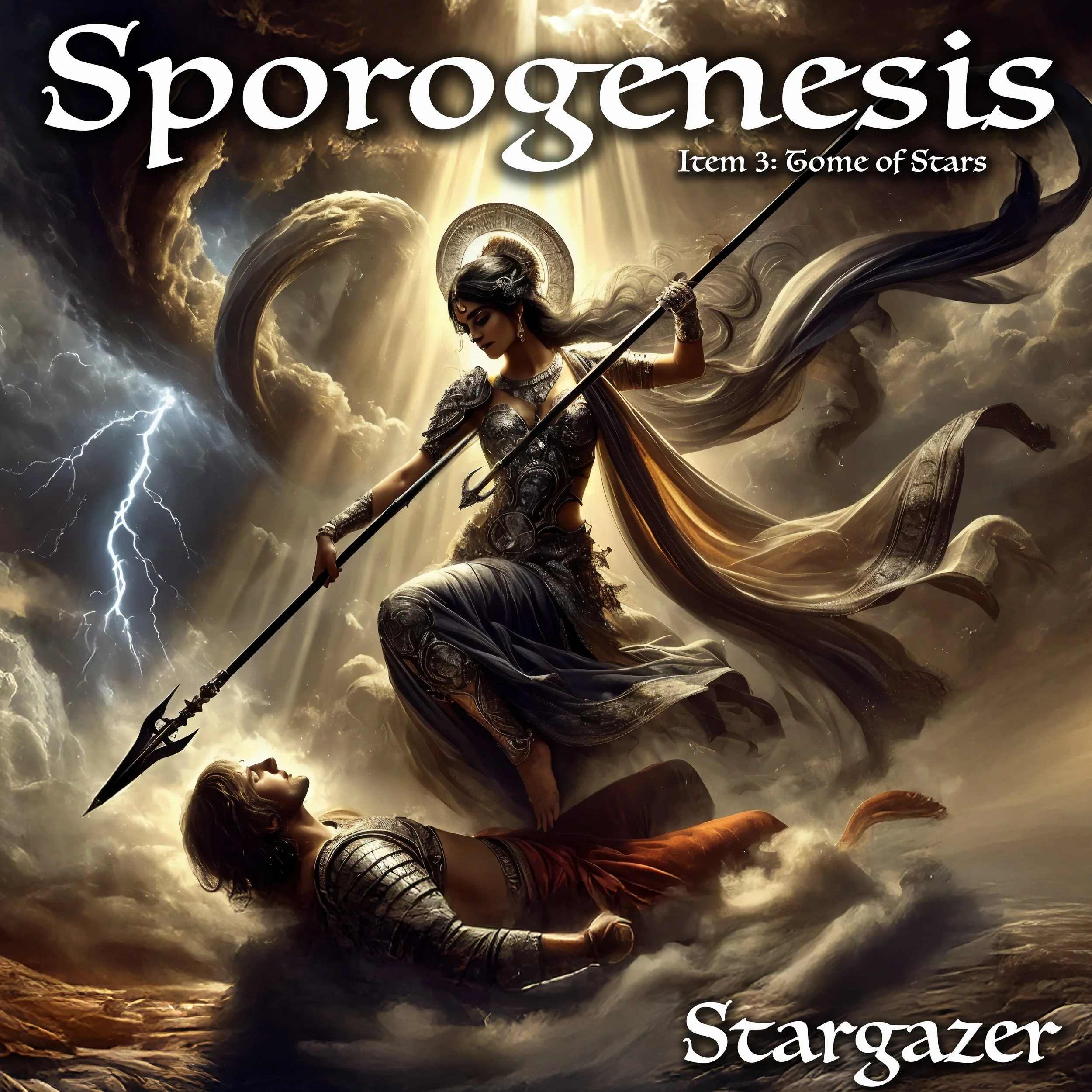
Sporogenesis: Introduction
The third item of Tome of Stars is Sporogenesis, a haphazard chronicle of the years 2011–2020. It is a shift from the cataclysm of Senescence into a period of withdrawal and emotional hibernation, imagined as the padam of the collection’s Bharatanatyam-inspired structure. This item is titled from the biological process of spore formation, and is a metaphor for self-preservation, preserving fragments of love and self in isolation from an external and internal universe too hostile to survive with open feeling.
In classical Indian dance, padams are slower, contemplative items often focused on shringara rasa, the emotion of love in a broad sense, especially in longing, separation, and divine interaction. Sporogenesis thus intentionally opens with the poem Padam, the verse describing a cosmic dancer who is named Shringara, thereby attempting to incarnate in choreography the aesthetic and emotional elements of this rasa. She narrates in dance the poet’s tragic love story:
Shringara’s dance, once swift, now softly wanes,
Her pinions furled, she weaves a lovelorn song
The poems that follow document a soul withdrawn to survive, unsure of future healing or further obliteration. There is a slow drift of memory and a steady questioning of meaning in the wake of loss. The spore is programmed to survive the harshness, as the poem Diamonds & Dust declares:
Though starved and damned, for you my love remains,
Weak respite through long torture and thorned chains.
And yet, a stirring breaks the surface during and after the 2020 COVID-19 lockdown. The stillness of the world outside and removal of many external stimuli forces a confrontation with the locked chambers within. In that silence, the poet dissects aspects of his psyche that had eluded him for five decades. The Once Upon a Time quartet of sonnets with their revelations about childhood trauma and the inherited wounds and behaviors, arose during this period. The chains of shame, fear, and self-betrayal for the benefit of others, long-trained into him, are revealed to his awareness. He finally grasps his inability to live truthfully to himself and his emotional devotion to the Stargirl.
This leads to action. In Unanswered: Letter, May 2020, the poet risks a painful and vulnerable outreach to her. He shares the revelations he uncovered. He confesses what he had hidden throughout their relationship: shame of his past, deep abusive trauma (the source of his behavioral paralysis), and the love for her that had always burned alongside it. The letter is a deep act of truth and faith, a desperate hope that her understanding might restore what was lost, or at least convey to her the truth of his adoration. However, he never receives any answer to this long confessional (and still has not many years afterward).
The final sonnet of this section, Letter, December 8th, 2020, considers a physical letter and gift he sent near the end of the pandemic year. Among many words, he wrote to her the refrain “come back to me”. It is a message steeped in mind-wrecking sorrow and desperation. It had become a mantra for deliverance from the blighted state and pain her absence had engendered, chanted in private moments. The spore is desperately seeking fertile ground to live again.
But the universe is often cruel and capricious. The letter falls into the wrong hands. Her privacy violated, the beloved reacts not with the compassion that he desperately sought, but with fury and judgment. Her reply is scathing. She calls the poet repulsive. She writes that she never wishes to hear from him again. She labels their time together a “nightmare.”
This item thereby ends with a devastating blow. The decade-old spore that dared open to her in the light of personal revelation, is crushed beneath the heel of happenstance and antipathy. A shattering and unmaking with rebirth vehemently foreclosed. This devastation is recounted in the last couplet of the closing poem of the item:
The new year dawned, but you replied with bile,
Your soulmate slain on spear venomed and vile.
This fall drops the poet into the hostile landscape of Item 4: Anemochory, which is perhaps the darkest and most tormented section of the collection (at least from the original six items of the book, Tome of Stars - a subsequent musical album, In Darkness and in Light, treads in deeply shadowed realms as well).
***
The “Item” structure of Tome of Stars is inspired by the recital program of a classical Indian dance form called Bharatanatyam, which became tightly associated with the Stargirl in the author’s mind. When assembling this collection, he decided to attempt to structure it following the margam, the structured program for performances of this art (“margam” translated as “path” or “journey”). He did this in two ways. First, Tome of Stars was divided in six Items (how the different dances in the recital are typically called in English). These six sections are both thematic and chronological, spanning the beginning of the relationship (Item 1: Anthesis, the flowering) through its dissolution to the poet’s final unending, prolonged grief and emotional devotion (Item 6: Scripture). Within each item, the actual elements of a margam show up as individual poems titled by the item name. In these sonnets, the poet tries to meld traditional interpretations of the dance item with elements of their narrative and personalities. More can be found in the video linked in the Background section.
Dance, Stars!
Dance, stars!
Grace bright cosmic souls,
endless hearts
within lost skies.
Art flames upon star chains!
There lies Void’s
sacred madness,
a sweet, shattered
space of truth-pain.
Thus, kiss song-joy, magic mortal!
Beneath worlds,
divine, sublime gods
shall dawn tears
in wild touch!
Dance, Stars! was not written so much as it was assembled as poetically as possible from a word frequency breakdown of the remainder of the collection. (Seriously)
After finishing the first drafts of Tome of Stars, the poet undertook various breakdowns of the text searching for literary "tics", both known and unrecognized. Many automated tools exist to perform such work (which he has used for his novels in the past), and indeed he found that he had even in this (relatively smaller as compared to his novels) collection a set of repeated phrases and words that could not be justified in their repetition solely by the needs of the poem, but which likely find their deep roots in his subconscious. It is impossible to root out all such verbal traps, but one can seek to reduce their occurrence.
As part of this, he had one such tool generate a word and phrase frequency list. The phrase list was most useful for exact reuse sins, prompting some reconsiderations and rewrites of some sonnets. The word frequency list also prompted changes, although this was more challenging. However, as he was looking at the list, his mind started stringing the most frequent words together into phrases. Before he realized it, he was composing a poem with the absurd constraints of (1) keeping the frequency order as much as possible and (2) not introducing any other nouns or verbs, but allowing himself to introduce articles, prepositions, and other elements (and at times modifying the words—changing singular to plural, verbing nouns, etc.). He mostly kept to the rules.
The end product shocked him in being not only a poem he enjoyed reading, but also one that felt like an eccentric but not inaccurate encapsulation of the collection. He then decided to include it as an Epigraph and Foreword, inaugurating the book.
Studying this poem itself is an analysis of a distilled version of Tome of Stars, the context lost in a mapping of meaning to numerical occurrence. The word choice is built into the manner in which the poem was created and reflects, in a direct but distorted manner, all the verse that is to come. To expand on why these words appear, and in the order they do, and what it means vis-à-vis the author's intent, would be to try to distill the planned poem-by-poem analysis into a single essay.
That will not be done. Instead, it will be left as a preview — a “teaser trailer” for what comes — as it both summarizes and also resamples to near meaninglessness what comes after, whatever the poet’s efforts to imbue a loaded word list with its own life.
Padam
Shringara’s dance, once swift, now softly wanes,
Her pinions furled, she weaves a lovelorn song:
Two spirits twined by fate’s resistless chains,
Spark arcane flames—a bond both fierce and strong.
Lithy limbs with love caress the endless skies,
Yet sorrow stings her eyes with winter rain.
Reborn fate’s dungeons, lovers’ last goodbyes,
Rend hearts enveloped in unending pain.
She writhes in torment, star split in the dark,
Her silent scream stretched stark through timeless space.
Grand galaxies are maimed with glowing marks.
Marred adoration weeps upon her face.
At last, I grasped the pattern in her stars,
And Shiva laughed: her story now was ours.
In classical Indian dance, padams are slower, contemplative items often focused on shringara rasa, the emotion of love in a broad sense, especially in longing, separation, and divine interaction. Sporogenesis thus appropriately opens with the poem Padam, the verse describing a cosmic dancer who is named Shringara, thereby incarnating in choreography the aesthetic and emotional elements of this rasa. She narrates in dance the poet’s tragic love story.
It begins by noting that the dance of love that was once swift, now “softly wanes” as this angelic embodiment of romance has “pinions furled” now singing a “lovelorn song.” This is the transition from Anthesis through Senescence, a summary of what came before and presentation that the divine dancer is telling that story.
It is a tragic tale, where her abhinaya weeps “with winter rain.” The poet’s past prisons, once seemingly banished by the Stargirl, are “reborn” in “lovers’ last goodbyes.” The “unending pain” of their separation is manifest in the dance of Shringara, where she “writhes in torment,” a “star split in the dark.” The transcendent imagery of wounding continues with “her silent scream stretched stark through timeless space,” where “grand galaxies are maimed with glowing marks.” All that was once the glory of the Stargirl and their love is rent and destroyed, the imagery remaining at this level to convey the subjective sense of loss and pain within the poet (seen again in the song “Event Horizon” from the album In Darkness and in Light).
The last two lines are enigmatic, even to the poet. They almost felt like revelation. He finally “grasps the pattern in her stars,” comprehending the meaning of her dance, where the cosmogenic mythos is written into the fabric of spacetime, thus alluding to some kind of transcendent narrative. A narrative he perceives and understands, but still does not comprehend (in a nod to River Tam). This is a divine theme, beyond mortals, so that Shiva, the god of the cycle of creation and destruction, of renewal from brokenness through erasure and recreation, laughs in his regenerative dance. The poet is granted a flash of unfathomable truth about their particular narrative, one constellation in a broad universe, its pattern told in dance by the incarnate rasa of mortal and divine love, where the god of dance, creation, and destruction rejoices from the immortal perspective at what to the poet is mostly grasped as tragedy and brokenness embedded in finite time.
Princeton
My footfalls sank within the woodland snows,
Where white embraced the earth in silent sleep.
I lost my way to find paths in that glow,
Beseeched the failing light for word of thee.
The tapestry that binds us—star and gaze—
Wailed wildly past the world of flesh and bone.
While how or when was wrapped in frosted haze,
A Voice confirmed a life we’d call our own.
And though the raging storm will darken day,
Dread demons ripping me from peace once more,
Sequestered is this vision love relayed,
A gemstone locked within my deepest core.
In pain, I drift through tempests cruel and cold,
But madly clasp this myth that I was sold.
Princeton narrates a real walk in the woods outside the university of that name. It is an experience that the poet wrote and shared with his beloved, an email from which the poem was written. It is thus a flashback to an earlier time before their separation.
The event occurred in the heart of winter, the ground deeply snow-covered, the period early in the seven years of the couple’s relationship. Having recently gone through trauma with respect to his failed marriage and his adoration of the Stargirl, their enforced separation is a confusing agony to him. He wanders into the woods without map or destination, hoping that as he “lost his way” - surrendering intellectual and emotional efforts to solve their challenge - he might “find paths in that glow,” in other words discover (through relinquishing search) the answers to his needs.
As he is chilled in the cold and blinded by the sun’s reflection in the snow, he finds his awareness perceiving the “tapestry that binds us”, and in seeing their reality, their true nature, he encounters a “voice” that makes clear to him that the couple will indeed be together. He leaves that mystical moment in the woods, taking back with him “a gemstone locked within my deepest core.” This is hope and a promise that he will return to in the years to come.
In the closing couplet, however, the later day poet writing the verse injects his loss of faith. Even as he “madly clasps” the vision in the woods in his darkest struggles of grief, he now names it “this myth that I was sold.”
A Grand Unification Theory
When Radha parted paths with Krishna’s heart,
The cosmos cracked—its symmetry undone.
As we, failed gods, now drift an age apart,
My world dims dark beneath this blighted sun.
While cosmic law lies shattered in this crime,
Should sunsets paint the evening sky with flame?
Dare beeches orchids hold in dance sublime,
When our divorce derides our coupled name?
Can beauty touch my eyes, no soulmate near?
What color shines when every shade bleeds gray?
I die a truth that’s watered by our tears,
An endless discord, pregnant with decay.
Outcast, I wander, nature’s dawn denied,
Till harmony returns you to my side.
In the reality of the poet’s contemporary world (the time he wrote Tome of Stars and after), he experiences reality as a creature numbed and stripped of natural response to beauty and emotion. Sunsets may “paint the evening sky with flame,” but such sights that once deeply moved him are cold and lifeless. Each spring he feels as if layers of unreality insulate him from the blooming world, and he remembers curiously how different it once was. He looks upon beauty, music, and art and is an ageusiac of many experiences. It waxes and wanes, at times his ability to experience the richness of aesthetics returning like some sickened patient regaining temporary consciousness in bed. But it also frequently collapses into coma, and he walks through a grayed and dead world that “dims dark beneath this blighted sun.”
A Grand Unification Theory considers this reality and rummages for causes, concluding that the split from the beloved in fact demands such a loss of experiential joy. He compares it to the fallout from the split of Radha and Krishna as narrated in Rusali Radha, Rusala Madhava, where the divine separation wrecks the cosmic order. For the poet "our divorce derides our coupled name,” and thus his cosmos withers. Combining this fracture of cosmology with his separation from the Stargirl, the only solution to heal the universe is the title of the poem. This is an allusion to modern physics and its search for a combined theory to explain the forces of nature (and the observed “broken symmetries” between physical forces, echoed here with “The cosmos cracked—its symmetry undone”). A reunion in love of the poet and his beloved.
Until “harmony returns” to his life, he he will be “outcast,” with “nature’s dawn denied.” Thus A Grand Unification Theory is the self-aware model of the poet’s emotional cosmos.
Diamonds and Dust
My heart you own, though shackles strap my soul.
A net of spirit debt secures me tight.
Yet still, my life is yours, you make it whole.
Deep in your eyes resides my only light.
Surrender now my thirst to understand.
Reject what faith and reason bellow true.
Relinquish hope, and all its cruel demands.
Imbibe scorched sands that stretch beyond my view.
Stand stripped—my walls of stone rough ripped away.
Kneel nude—the desert dust will flail me raw.
Weep wild—the madness whirls both night and day.
Taste lips the diamond heavens will withdraw.
Though starved and damned, for you my love remains,
Weak respite through long torture and thorned chains.
In another nod to Joan Baez (and her song Diamonds and Rust), here the poet lays out the nature of periods of complete surrender to pain and loss. Not to overcome loss or move beyond it, but simply to experience it because it is truth. With opening phrases such as “My heart you own,” “My life is yours,” and “in your eyes resides my only light,” he is stating his existential and emotional foundation. He can shut down his feelings (as he does in much of Sporogenesis). In contrast, at times as in this sonnet, he can “stand stripped,” “kneel nude,” and “weep wild” in letting his feelings flow. The ultimate reality is that he remains “starved and damned” while “my love remains,” and it is a balancing act of survival to starve from feeling or to feed himself with affection that loss always brings with “torture and thorned chains.”
Oasis
I know not what wrong weaves from all I write,
Still striving to stitch verse with hope, not woe.
Your silence tempts my pen to scream my plight,
And to your ghost my deepest feelings go.
In deserts long confined, I glimpsed a stream,
Imagined you were drinking there beside.
Mirages mangle when we wake from dream,
And thirst consumes as reveries subside.
Forgive me, love, for living lies of you,
Forged phantom of my heart’s malnourished need.
Your absence birthed a canvas, visions grew,
And frantic hopes forced fantasies to breed.
While wisdom warned, my reason I betrayed,
Forsaking truth to hold your haunting shade.
Oasis continues what was engendered in Sempiternal, namely the construction in the poet’s mind of an alternative reality, a simulation, in which the beloved was accessible to him. It begins with a description of a real dream. For many years, including even a decade and a half later when Tome of Stars was written, the Stargirl would appear many times in his dreams. Those spanned the gamut from highly personal encounters (intimate or confrontational) to almost robotic sequences where he could only glimpse and experience her presence but not communicate. After each, he would wake to a fresh wound of loss.
Oasis extends that dreamscape fantasy world to the waking day where her “absence birthed a canvas, visions grew” and his longing for her “forced fantasies to breed.” While entertaining these specters of the beloved in dream or waking reverie, he was cognizant of the unreality of his mistress, and while his “wisdom warned” him of the dangers, the poet notes that “my reason I betrayed/Forsaking truth to hold your haunting shade.” Like in Sempiternal, mitigating her loss, even in simulation, was a reality he could survive within, whereas facing the full truth of her absence, was not.
Visions
Good morning, Stargirl. Still, I think of you,
As every waking since our wrecked goodbye.
Your memory adorns the dawn like dew,
A gift to grace the glow sketching the sky.
I fall asleep with visions of your face,
And wake, your ghost a fading mist nearby.
In dreams, we voyage through a timeless space,
Beyond the reach of what, or where, or why.
If there’s a road beyond what reason writes,
A realm where love transcends what we confine,
I hurl my heart to reach that healing light,
To whisper words that cannot be defined.
Cast anchor in this transcendental sea,
I wait, reborn by eons, endlessly.
In parallel with Sempiternal and Oasis, Visions speaks of the enduring presence of the beloved in the poet’s awareness. Even when not indulging in fantasy worlds and simulations in which he encounters and speaks to her, his day-to-day life was moment-by-moment haunted by her ghost. He woke to thoughts of her, with or without waking from dreams. He felt her presence in the airs, the sky, the very light of day. He would find his mind occupied with thoughts of her when trying to sleep. Not merely for a short period of time after their separation, but for years, decades, the intensity and frequency oscillating, but ever present. In this sense, like in Entangled, he feels a psychic link to her that he cannot break, but which is not reciprocated. Yet he hopes it can lead him in some transcendental reality to be in her presence once more. So he ends the poem with: “I wait, reborn by eons, endlessly” where he journeys to find “a road beyond what reason writes” to “reach that healing light.”
Heidelberg
In northern tracts, where rays play tag with time,
Our star shines slant, so colors steal fresh hues.
The tinted mist transforms as seasons rhyme,
In silent pressure, each full moon is new.
A soaring tree stood framed by stream and skies,
Chromatographic riot stained the clouds.
The painted river currents mixed the dyes,
The branches silhouetted and unbowed.
I gawked upon the bridge and froze in place,
Gloves fumbling the camera in my coat.
The lens immortalized a ghost in grace—
From symphonies of sight, caught one bright note.
And so my sonnets stumble, mute and lame
Before your glory—barren, ashed, and maimed.
In the middle of his career, the poet moved to Germany, specifically the university city of Heidelberg. One of the things that struck him upon living there for a few years was how differently the seasons passed. Heidelberg has approximately the same latitude as Toronto, Canada, which surprised him when he looked it up. He had possessed a biased view that the United States was similar to Europe in its location on the globe (perhaps from many assumptions about shared culture and history extending to geography). And while “similar” could be viewed as correct by some, it is simply the case that Europe in general is a good bit more north than the United States. And he felt this difference in the changing of the seasons, in particular the difference in the light. Not just how long the day had light, but (1) how quickly the amount of daylight changed from season to season (the more dramatic endpoints in seasonal daylight, understood perhaps better to contemplate the poles, requires logically a more rapid change in the amount of daylight to reach those extremes over the finite and identical time period of seasonal change on the planet) and (2) the quality of light due to the angle of the sun through the atmosphere (basically differences in atmospheric scattering, where shorter wavelength, bluer light is absorbed more, like at sunset but less dramatic, the further you go north).
In this different world “where rays play tag with time” and “our star shines slant, so colors steal fresh hue” the poet came across a particularly dramatic scene of a sunset by the Neckar river. While the truth of A Grand Unification Theory was generally held, in this instance the shocking beauty of the scene broke through the collapse of his aesthetic senses and he did something he had come to pursue less and less since his loss of the beloved: he wanted to preserve the moment in photography. Yet while he does a competent job of taking the picture, as is often the case when comparing the subject, binocular, brain-processed imagery of life to the two-dimensional film or digitally encoded light input from the same scene, the artifact is experienced to lack deeply.
Years later, writing the sonnets, like with the poem Kiss, he laments a isomorphous impotence of words to engender in the mind the experiences about which he was writing. In particular, he feels words fail utterly in capturing his subjective experience in the presence of the Stargirl.
Incarnate
Forgive the burden anguish laid on you,
A fool, I named you savior of my soul.
Convinced your star could all my storms subdue,
I failed to see no part can fill a whole.
Cruel time’s harsh hand has hewn away the stone,
Exposing human flesh, both real and true.
Flawed gem, no goddess sits upon her throne;
Soft blemished beauty blends to fashion you.
You’ll ever burn with brilliance, sublime bliss,
A curse and blessing woven into one.
But now I seek the substance of your kiss,
A woman’s vibrant heart beneath our sun.
To walk, to talk, to touch each day and night,
Your mortal glance still renders darkness light.
Showing that the poet could at times view his adoration of the Stargirl through open eyes, Incarnate is a dissection of idolatry in love. Beyond the common tendency of many in romantic connections to elevate a beloved to unrealistic and inaccurate levels, the poet also brought his psychological pathologies to the mix. As mapped in the Once upon a Time quartet (especially Part 3), the deep wounds and warpings of childhood and adolescent abuse left the poet with many maladaptive traits and behaviors. One survival mechanism he used (discussed in the Background section involving Tolkien and his character of Varda), was that he used fantastical, mythic figures as psychological anchors to get him through the darkness of his youth. These figures became salvific in this sense, and thus when the Stargirl herself came into his life, and he mapped her to these deeply internalized archetypes, he did indeed feel delivered: “I named you savior of my soul/Convinced your star could all my storms subdue.”
In this sonnet, the poet admits that he is aware of this distorting construct, and apologizes to the beloved while noting that there is little he can do to prevent it from happening. He thus presents a dualist existential state, one where he elevates her beyond anything productive or healthy to him or to her, unable to avoid it, and yet is aware of this aspect of himself, and wishes he could work to know her “blemished beauty” and “woman’s vibrant heart,” longing for a practical life (as tasted in Into the West) with her beyond mythology where they would be able “to walk, to talk, to touch each day and night.”
Lockdown, 2020
Dead desert decade, dungeoned, deaf decay,
Each night, black mirror of a perished morn.
Your absence—mad anarchist cancer—brays,
Vile, venomed toxins rending veins with thorns.
Starved sporulation to survive the void,
In adamant encased, the spirit seized.
In stasis, feelings frozen, cursed android,
I hibernated, hoping to be freed.
At last, I ventured vines into this night,
A twisting touch that seeks your star’s embrace.
Blind branches brave the black, and burn for light,
Wild hope for haven in your hallowed space.
I chose to risk, to dream, to know your sun,
To hold your hand and let our hearts be one.
Lockdown is a summary and transitional poem. It begins by distilling (with the letter “d”: “Dead desert decade, dungeoned, deaf decay”) the near ten years between their parting in 2011 and the transformative introspections he had during the COVID-19 lockdown. In this terrible period of Sporogenesis, where he is “starved to sporulation to survive the void” and “in adamant encased” as a “cursed android” who “hibernated, hoping to be freed,” that period of revelatory self-reflection opened in his heart the hope that he could convey to his beloved the terrible reasons he had acted as he had. That she would find empathy and forgiveness at the least, and perhaps “come back to him” in his most deep desire. So, he cryptically notes “at last I ventured vines into this night” to seek her “star’s embrace,” where he chooses “to risk, to dream” of their reunion.
Behind the vague words in the poem (detailed more in Unanswered: Letter May 2020) was a concrete outreach by the poet. He penned (or rather, typed) a thirteen-page letter to the beloved in which he spelled out the results of his fifth-decade self-analysis. He summarized his history of abuse and how it shaped his perceptions and behaviors, presenting her with his model for how that led to the hurtful choices he made that she could not understand. This was the terrible risk he took (to his mind). Not just in braving a horrific rejection - what was terrifying was the context of that rejection: the abuse he suffered. This abuse consisted of events that undermined everything he wanted to be for her (to his mind): a traditional gendered conception of what a man was and the view of his character as noble and worthy of respect. Maternal emotional and sexual abuse and manipulation seemed utterly incompatible with any woman perceiving him in a positive manner. For this reason, he had never dared broach this aspect of his past with the beloved. He even pushed it away from his own mind, striving as he would write in the sonnet Tillana, to outrun the beast from the pit (the sum demon of his damage and past that ever threatened to swallow him whole). In these pages sent in May 2020, he put it all “on the table” for the hope to find his way back to her.
In the end, tragically, it was only offering himself for emotional slaughter.
Unanswered: Letter May 2020
In quarantine’s long shadow, time transformed.
My mind embarked on quests through sleepless nights,
Exploring past mistakes, ardor deformed,
Unearthing reasons for our stillborn light.
In dream-wrought worlds, some truths I’d come to find;
I loved you worthy of a mythic tale,
But could not shatter shackles on my mind,
Nor unmake fiend’s corruptions and prevail.
My thirteen pages bled from mangled heart,
Confessed in raw vulnerability;
No lack of love had ripped our worlds apart,
But shadows cast by past monstrosity.
Long years this open wound, where’s your reply?
Starved vultures rend my flesh. Yet I don’t die!
Following the decision to reach out to the beloved in the last poem (Lockdown), the poet writes the “thirteen pages bled from mangled heart” that are “confessed in raw vulnerability” where he dissects his shameful past of abuse and how he feels it sabotaged their relationship. He summarizes the time spent coming to this understanding in “quarantine’s long shadow” that led him to “unearthing reasons for our stillborn light,” the causes of their breakup (from his side). He asserts with deepest belief that “I loved you worthy of a mythic tale” but that he could not “shatter shackles on my mind,” that were due to “past monstrosity.”
The sonnet ends with a bewildered and damaged question: “Where’s your reply?” He sent this deep confession and yet never received for “long years” any answer, not even an acknowledgement of its receipt (and in 2024 he wrote begging her to at least answer whether she had read it). The poem ends with “Starved vultures rend my flesh. Yet I don’t die!” which is the poet’s best attempt to provide imagery for how this silence in the face of such a rending confession has affected him.
He Who Cries Out, Longs to be Heard
What drew you here, our sadness, or our bliss?
The wise care not—the world was remade, whole.
The stage you dance, the paths your feet have kissed,
Are sacred ground that hallows every soul.
That day I saw your face, my spirit stirred,
Yet madman’s chains now silence what I feel.
I speak to shadows, whisper every word
In music sung, and writings long concealed.
Each day, long nightmared nights, I chant your name,
While walking with your wraith through endless dreams.
Gaunt, homeless hymns—they fall, fractured and shamed,
Into a pit that swallows mankind’s screams.
I weave wild whispers, tapestries through time,
To seek your heart in prayer and ardent rhyme.
This poem is mentioned in the Forward to the Analyses section of the website, where it is noted that:
One poem in the collection was initially titled “Ciggendra Gehwelc Wile Pœt Hine Man Gehere”, which is Old English for “He who cries out wants to be heard.” I chose this not out of a love for (or even knowledge of) Old English itself, but because important elements of symbolism in Tome of Stars have ties to a significant figure from my youth: J.R.R. Tolkien. One of Tolkien’s main biographers and defenders, philologist Tom Shippey, writes in his book J.R.R. Tolkien: Author of the Century:
“Some have felt (and said) that he should have written his results up in academic treatises instead of fantasy fiction. He might then have been taken more seriously by a limited academic audience. On the other hand, all through his lifetime that academic audience was shrinking, and has now all but vanished. There is an Old English proverb that says (in Old English, and with the usual provocative Old English obscurity), Ciggendra gehwelc wile pœt hine man gehere, ‘Everyone who cries out wants to be heard!’ Tolkien wanted to be heard, and he was. But what was it that he had to say?”
Similarly, some deep part of me clearly wants to be heard as well. Generally, and, despite her devastating antipathy toward me, by the Stargirl herself.
While beginning with a contextualization of his long adoration and loss, this poem encapsulates the poet’s many-yeared efforts in writing the Stargirl, trying to communicate with her directly or in his own private world:
I speak to shadows, whisper every word
In music sung, and writings long concealed.
Each day, long nightmared nights, I chant your name,
While walking with your wraith through endless dreams.
Writings and songs, letters, journal entires, chants. They are all “Gaunt, homeless hymns” produced in secrecy that “fall, fractured and shamed/Into a pit that swallows mankind’s screams.” All are “wild whispers, tapestries through time” “To seek your heart in prayer and ardent rhyme.”
The poet is desperate to be heard and loved by the Stargirl again.
Letter, December 8th, 2020
In May I sent you thirteen bloodstained scrolls,
Where I dissected every organ sure,
Shared insight to the breaking of my soul,
That you might understand my love was pure.
I followed with one hundred ardent mails
To that account we shared in storm-wrecked years,
Ten thousand pieces of my heart detailed,
A million pixels pregnant with my tears.
I wandered through the ruins of our vows
With beggar’s verse, a chant I’d plead in vain;
Petitioning, a rose I placed and bowed,
In hopes you’d answer prayers and end this pain.
The new year dawned, but you replied with bile,
Your soulmate slain on spear venomed and vile.
With this sonnet, Sporogenesis ends, not on a note of triumph or deliverance, but instead with ruinous defeat and psychic mutilation. Despite (or because of) the lack of response to the poet’s long letter in May 2020 (the “thirteen bloodstained scrolls” that “shared insight to the breaking of my soul”), he begins writing to her at an email account they privately shared during their relationship. He sends literally hundreds of emails, and figuratively “ten thousand pieces of my hear.” Yet nothing from her. Not an acknowledgement. Not even a request to stop writing her. He knew only the void. The silence driving him mad, he composed a second physical letter to her at the end of the year, including with it a gift of a rose:
I wandered through the ruins of our vows
With beggar’s verse, a chant I’d plead in vain;
Petitioning, a rose I placed and bowed,
In hopes you’d answer prayers and end this pain.
Cruel fate laughed as the letter was delivered to the wrong address into the hands of strangers, exposing the beloved to public humiliation (in her eyes, as she was and is an obsessively private person). Only this was sufficient to elicit a response from her, and it was horrific and damning to him. She eviscerated his mistake, his character, their shared history, and stated that she would never meet his mantra to come back to him, and never wanted to hear from him again. Rather than the loving response he desperately sought to his confession and longing, he received a spiteful missive, where she “replied with bile,” and with which the poet was “slain on spear venomed and vile.”
The response put him in a near dysfunctional state for many months. He did not attempt to contact her again for several years, his cancer diagnosis and surgery the prompt that would give him the courage to risk such damage again (although he was more prepared for it at that point - and only received silence).
In the margam of Tome of Stars, this sonnet brings to swift destruction the spore and seed of hope, and closes the item of Sporogenesis with ruin. The poet emerges shattered into particles that are scattered to the winds of the next item, Anemochory.