
Making Tome of Stars:
Process and Meaning
“Computers do not create art; people using computers create art.”
—Aaron Hertzmann, Can Computers Create Art?
Introduction
Tome of Stars is a unique project in the history of my artistic endeavors, undertaken at a time of monumental change in the tools available for creative expression. The subject of the work has been the most consequential emotional experience of my life, and my goal was to make as beautiful and devastating an offering to the universe (and the Stargirl) as possible based on this transformative experience.
In every aspect of what I’ve done to realize my emotional vision, I have used a plethora of technological tools, including generative AI (in writing, in graphics, in music). When I began the work, this latter tool was so new that its parameters in culture were completely unset. It is now clear that much of the initial optimism and experimental enthusiasm many (including myself) brought to it has been replaced with concern, suspicion, and outright rejection. Generative algorithms in art are particularly disdained at the present moment as I write this, and clarity regarding their use is now demanded in writing, graphic arts, and music.
Therefore, as I come to the close of this three-year project, I have put this account of my efforts using these technologies here. I’ve divided the discussion into two main sections. The first is an explanation of the mechanics of my process, how I did things, how it compares with and incorporates my pre-AI writing approaches, how it differs. The second is a broader consideration of the value of what I have produced, touching briefly on some of the objections to generative AI in art, such as the meaning of intent and voice in the context of this new technology.
I’m not here to plant any flag or defend any agenda, but to be transparent in what I have done in this tumultuous age and comment on what meaning I believe it has. I invested three years of my life, pouring as much time into this project as multiple novels I have written. It is a verse, graphical, and musical narrative about my beloved and my life with and without her. From method to meaning, it is my heartfelt journey shared freely and vulnerably with the world, done so in the spirit of all artistic effort — to touch disparate souls with meaning and forge connection, not division.
Part 1: Process
Tome of Stars is a unique project in the history of my artistic endeavors, undertaken at a time of monumental change in the tools available for creative expression. The subject of the work has been the most consequential emotional experience of my life, and my goal was to make as beautiful and devastating an offering to the universe (and the Stargirl) as possible based on this transformative experience.
In every aspect of what I’ve done to realize my emotional vision, I have used a plethora of technological tools, including generative AI (in writing, in graphics, in music). When I began the work, this latter tool was so new that its parameters in culture were completely unset. It is now clear that much of the initial optimism and experimental enthusiasm many (including myself) brought to it has been replaced with concern, suspicion, and outright rejection. Generative algorithms in art are particularly disdained at the present moment as I write this, and clarity regarding their use is now demanded in writing, graphic arts, and music.
Therefore, as I come to the close of this three-year project, I have put this account of my efforts using these technologies here. I’ve divided the discussion into two main sections. The first is an explanation of the mechanics of my process, how I did things, how it compares with and incorporates my pre-AI writing approaches, how it differs. The second is a broader consideration of the value of what I have produced, touching briefly on some of the objections to generative AI in art, such as the meaning of intent and voice in the context of this new technology.
I’m not here to plant any flag or defend any agenda, but to be transparent in what I have done in this tumultuous age and comment on what meaning I believe it has. I invested three years of my life, pouring as much time into this project as multiple novels I have written. It is a verse, graphical, and musical narrative about my beloved and my life with and without her. From method to meaning, it is my heartfelt journey shared freely and vulnerably with the world, done so in the spirit of all artistic effort — to touch disparate souls with meaning and forge connection, not division.
Background
I have written creatively since I was a teenager in the 1980s and first discovered the strange sorcery of 2D runes to engender visions before our awareness. I have written ten novels (one released through a publishing house, the others self-published) and several books of poetry. I have also written many peer-reviewed academic papers and book chapters. It is safe to say that my career and artistic endeavors have centered on writing, all of this before generative AI was remotely on the horizon.
In my life (now approaching sixty years), I have written by hand in spiral journals, used the first matrix-green text MS Word on cathode-ray-tube monitors the size of mini-fridges, celebrated the magic of copy-paste-delete to move text around like clay in a document (try that in a written journal), WYSIWYG, the miracle of spell check (greetings to my primary school teacher who told me I’d never learn to read well because my spelling was so terrible), felt giddy at the formatting options the Mac brought to writing and publishing, wrote ten novels, self-publishing nine of them after my first trad-pubbed novel tanked and I couldn’t get another contract (and was overjoyed at the tools to bring ebooks and print to the world as a DIY artisanal writer), and over the last few years, have grabbed every AI tool I could find to bring my creative visions to life in this project.
Writing Process for Tome of Stars
In constructing the sonnets in Tome of Stars, I combined my previous approaches for writing structured poetry with several modern tools, including online thesauruses, online rhyme dictionary/generators, and generative AI. In the past, all the way back to spiral notebooks, I would write out in prose what I wanted to say when producing a structured poem (e.g., a sonnet). First loosely, in a paragraph or two. Then I would cull that text down to the essence of what I felt was important, beginning a process of substituting imagery, symbolism, and metaphor in place of the more “prosaic” expressions. At this stage, I would start producing lines, moving toward meter and rhyme. I would then go through iterative steps of refining the lines to fit the constraints and rules of the poetry style I was writing in (obviously this is for highly structured poetry, as free verse did not require the same type of effort). I would often write multiple versions of a line, sometimes slight variations, sometimes five or six very different takes on what I was trying to say, with different vocabulary, imagery, etc. Part of the process was just generating options for expression and integration into the formula of the structured verse.
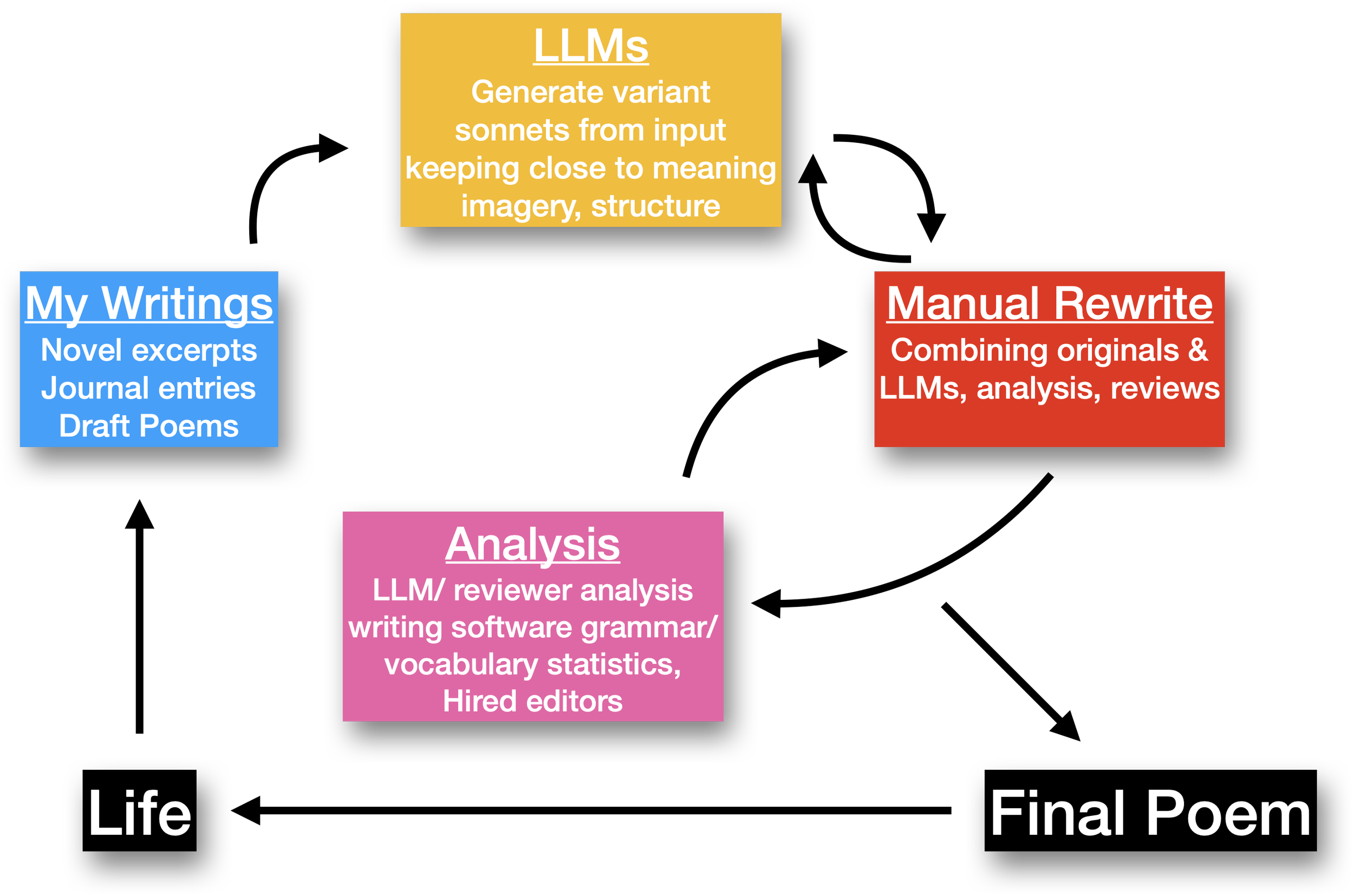
With generative AI, I was able to augment this process and create many more options at the expressive level. For each poem in the collection, I would begin with one of the following (also on a spectrum): (1) a sonnet draft at various stages of refinement, (2) prose lines organized in stanzas to guide the AI, or (3) sometimes just the prose from my journals, letters, and occasionally book excerpts for the later “companion” volumes to Tome of Stars. I would then have LLMs create highly defined, structured iambic pentameter verse from these provided writings (as best they could), instructing it to stay close to the meaning and organization I had (in the case of more developed writing) and to produce different sonnets varying in perspective, vocabulary, imagery, etc. This is similar to my own “by-hand approach,” but automated. For each poem, I might use 2–3 different generative AIs and ask them to output 5–10 sonnets from my initial writings. I would select from those.
I was using ChatGPT, Claude.ai, Grok, and Gemini as they existed in the 2023-2024 (e.g., GPT-4o, o1-preview, Gemini 1.5, Claude 3.5 Sonnet, Grok-2). These would return verse at various levels of competency, not infrequently failing to fit the meter and rhyme, and commonly producing (to my ear) painful verse, and certainly a lot of verse that did not fit with the intent and style I desired. Yet there were often elements I liked and found useful, especially when I produced a large sample size.
Next, I would have my original writings at the top of a text page and paste in the generative sonnets beneath. Line by line, using my original writings, I would hunt through the generated material for expressions, words, phrases, sometimes entire lines, that transmuted what I said into something that captured my intent and vision for the verse. This might mean I would chop and stitch together pieces of quite a large number of different synthetic poems whose verse otherwise was not used. When I felt I had something that was working to capture and express my source writings, I would then move to a completely manual portion of the process.
Here I would go word by word, line by line, and rework, substitute, completely rewrite, and in some cases leave just as it was, the interwoven building blocks from the synthetic output. Parts of this I might feed back into LLMs for refinement or generating many variants, which then would enter (or not) into the manual rewrite stage again. This would be a cycle of editing, regeneration, and rewriting until I had taken the text as far as I could go toward my vision.
Next, I would drop the finalized sonnet back into generative AI to (1) analyze it from both a literary and grammatical/syntactical viewpoint in a kind of a virtual poetry critique, leading to more rewriting, and (2) undertake a final polish to punctuate the verse according to English poetry norms (because I have never been able to truly grasp what seem to me the often quite arbitrary and inconsistent rules for punctuation, which other languages often disagree about quite strongly). I would also read the poems out loud and sometimes catch issues (to my ear).
I then subjected my entire collection to statistical analyses of word/phrase usage, frequency, clichés, etc., trying to find those vices in which my mind would subconsciously indulge (I used Autocrit, a writing-analysis service heavily employed in analyzing my novels pre-AI). Another round of edits would seek to purge some of these problems (and also inspired the creation of two new poems based on word frequency alone: Dance, Stars! and Frequency Modulated).
Finally, I hired freelance editors (e.g., Reedsy) who brought a professional eye to the work. Their comments required a final round of manual edits. Of course, writing never ends, it’s just abandoned at some point. I still find errors, both basic ones as well as “errors of art”. A good example of the latter is in the poem , where I realized I should have chosen a single word differently (“sign” instead of “sight”) for several impactful artistic reasons. But, I have ended the project, so it is what it is, imperfections and all.
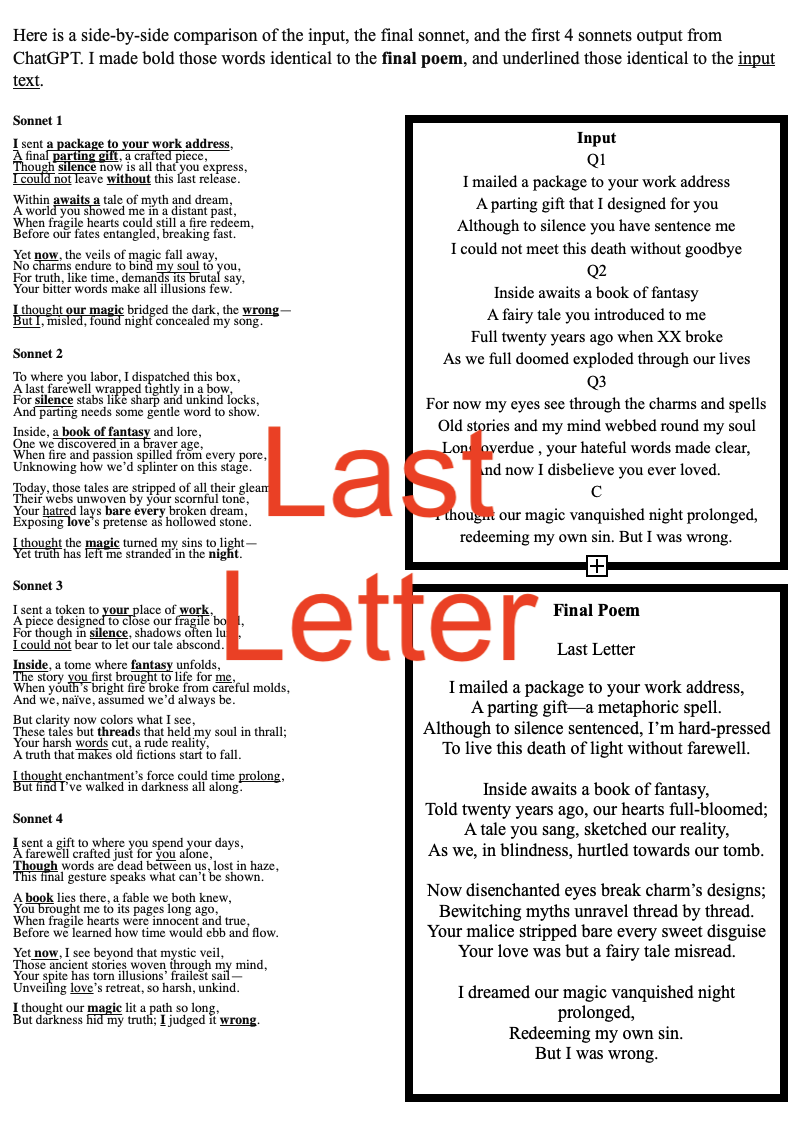
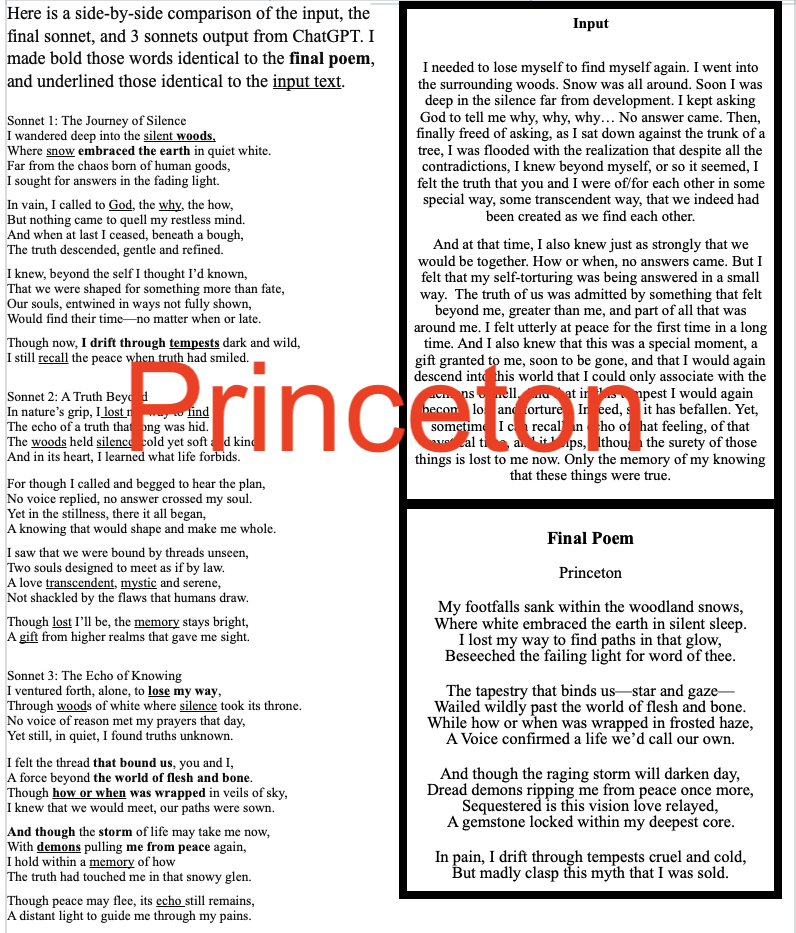
As brief and informal examples, I’ve linked below two poems that illustrate a little of the process with two starting points of my writing that lie on different ends of the spectrum. Last Letter (a rather late sonnet in Item 5: Quixotosis) begins from a draft sonnet with organized quatrains and a couplet, already mostly in iambic pentameter, but lacking the rhyming and some internal text marked by placeholders. In contrast, Princeton (from Item 3: Sporogenesis) began with an excerpt from an email I sent the Stargirl in 2005.
In all, the time spent to create a book of 100 sonnets (about 10,000 words) was equivalent to the time I took to write my novels (80–100K-word books). Because I have a day job that keeps me housed and fed, as with my novels, I found this time in odd hours of the day (usually at night). I would also note that the use of generative AI didn’t speed up the process. In the end it was basically similar to the time it took me to write sonnets before these tools became available. However, like with other aids (thesaurus, rhyming dictionaries, etc.), at each stage I had many more choices for ideas and language than my limited mind could produce. This was a strong motivation to use these tools, as my goal was to try to build the best verse I could in this long and absurd love letter about and to the Stargirl. Choosing from among the generated options from my initial writings did not take much longer than how I would have done it generating my own (less numerous) variants, but there were more options, and the time gained and lost basically balanced out.
Always guiding my efforts were the very real events and emotions underlying this story of transformative love, loss, and grief. Everything I did was to make the verse convey, as closely as possible to my vision and taste, the churning universe of feeling within me about my beloved. From journal entries to rhyme generators to ChatGPT/Grok/Claude.ai to statistical analyses, each of these elements served as the marble, chisels, rasps, files, polishing stones and paper that I used to produce earnest, honest creation.
Of course, I failed. We all do in trying to capture the uncageable mystery of feeling within us. But this was my writing process.
Graphic Art Process for Tome of Stars
I’ve always loved graphic arts, but despite much unfruitful effort in my life, neither possessed the talent nor could develop the skills to translate my ideas through my hands to a visual medium. Therefore, when generative AI came around to produce images from written descriptions, and after playing with it a bit and being very impressed with how my writings could generate graphics that I found beautiful and even moving, the idea of creating an illustrated version of Tome of Stars would not go away, specifically, a version of the collection where each poem had its own graphical spread in which it was embedded.
Again, I embraced generative AI for this project for its successes in graphics and also due to practical limits. To commission illustrations for the 100 sonnets of Tome of Stars was far beyond my means. I also was attracted to the idea that I could iterate the illustrations through sequential prompts, basing further generations on assessments of the images that came before, modifying the input, and continuing, aiming continuously towards idealizations I wished to incarnate.
I spent as much time producing the graphics for this illustrated version as I did in producing the book of poetry itself. The process here was different, of course. I was beginning with my own writings again, but not to transmute them into poetry, but instead into image. For each poem, I worked to produce visualizations that reflected what, to my mind, was some central aspect of the imagery of the verse. I would write prompts, produce images in several generators (Microsoft, ChatGPT, Grok, others), refine the prompts, ask AI to refine the prompts to yield specific illustrations in specific styles. The images were made in a developmental stage of AI graphics that had a lot of artifacts, so I also had a lot of post-processing to clean up, combine, and adapt to my book format. I logged many hours in Photoshop in these clumsy efforts. In the end, there are hundreds of gigabytes of images from this work, most never used, a few worked on until there was nothing more I could do. I could surely get even better images now with how the technology has progressed. But I don’t have the emotional energy to do it all again.
Overall, I was happy with the results. These tools allowed me to make a graphically enhanced version of Tome of Stars. I could bring the story of the Stargirl to image in various incarnations. Imperfectly. But at times, magically.
Music Process for Tome of Stars
Once I had an illustrated edition of the collection, I turned to music. At first, I thought I would record, with my very amateur guitar and singing skills, some folk songs for a few of the poems. But around this time I saw a video on YouTube about AI music. It was a bit startling in the claims it was making for generative music quality. I followed up with some of the music generators, and even more than for images, I was amazed. In a relatively short time considering the final product, I could produce songs I loved for the verse, in myriad styles, honed and converged to my own interests/style/purpose/quality, many becoming some of my favorite to listen to.
I have always loved music, listening in the dark to vinyl records of Pink Floyd and Bach in my basement as a teenager in the 1980s, stumbling my way through playing Dust in the Wind on my guitar, crafting and playing Native American style flutes. The songs I could produce with generative algorithms were, at their worst, highly competent if somewhat generic genre pieces. This alone would have been enough for my project, beyond what I might deserve, to hear the verse of my emotional journey sung well in so many styles. But some number of the songs were as good (to my artistic appreciation) as anything I had ever listened to. Expressive vocals, soaring instrumentals, dark or light, with memorable melodies. It was all there, and I play them now on my playlists as much as I do anything else. Perhaps more.
Unlike with the graphical generations that used multiple sources online that were fairly competitive with each other depending on the image, to my musical tastes, the system developed by the company Suno was (during the period I used it, 2024-2026), far superior to others. My process was similar from that point on to what I had done for the graphics. I would write descriptions, multiple versions for each poem and the type of song I wanted, and I would use those in Suno to make songs, but also feed those descriptions into LLMs to write more and varied prompts (so using AI to generate prompts for another AI in a feedback loop where my taste guided the process, selecting elements of prompts for what worked for me).
With Suno in 2024-2026, one could give an overall style prompt but also annotate lyrics to structure the song (harmony here, instrumental there, chorus, instrumentation, phrasing, etc.). The AI would sometimes listen, sometimes sort of listen, and sometimes do something quite different in unpredictable ways. It was a back-and-forth, no single approach best in general. I’ve generated 50–100 songs for many poems (Bridge of Bones from Celestial Mechanics took 195 before I was satisfied, and Last Song for Stargirl went through nearly 300 before it was all over). For other poems, it was one generation and I had a song I could not imagine bettering (Bright Star from Better Voices is one such example). Sometimes I could not get a song that worked for me in a given genre for a given poem, and I would radically change the genre and find success there.
Again, it was iterative and trial-and-error, many songs requiring (struggling-amateur) post-production in GarageBand to fix weird or bad regions, or cut-and-paste two or more generated song pieces together, or just play around (e.g., the absurd stereo swirls and flanger effects in Queried Letters (Prog) from the album Celestial Mechanics). I spent over a year on the music, roughly as much time as on writing or illustration.
As an example of song generation, you can skip to the end of this page where I’ve summarized the efforts in producing Last Song for Stargirl, the coda of the Tome of Stars project.
“Experiment 1 tested blind-listening evaluations and found no significant differences between AI-composed and human-composed music in perceived creativity and expressiveness. When authorship was disclosed in Experiment 2, AI-composed music was evaluated as significantly less creative and expressive, whereas evaluations of human-composed music were largely unchanged.”
—Siying Qin and Xueyang Zhang, Evaluating AI-composed music and human-composed music among higher education music students
Music: Transcriptions
In the spirit of offering this collection free to the world, I also have undertaken musical transcriptions from the generated songs. This work was commissioned from a well-respected musical transcription service that employs a global team of hundreds of professional musicians (including transcribers, arrangers, copyists, audio editors) with degrees in Performance, Music Composition, Musicology, etc. from established conservatories/university music programs. It was a huge collaborative project where they took on the 18 songs, learned about Tome of Stars, worked with me to realize my goal for SATB choral transcriptions that would be singable. AI “singers” are not constrained by the reality of voice biology, and direct transcriptions can in many places create unsingable sheet music. This did occur and we had to go back and forth. Also, AI music can be “muddied” in terms of the separation of voices, and we had rounds of back and forth on the sheet music when I didn’t feel their version captured what I was getting from specific passages, notes, phrasings, etc. I found myself on many occasions going in with MuseScore to change/add/subtract notes, move parts from keyboard to voices, transpose songs to fit vocal registers, etc. This process lasted over nine months from beginning to completion of the choral anthology.
All the songs in A Choral Dream are done and made available for download on the website, along with a print anthology of all the songs that are free to download as well and made available at cost to buy in print.
Overall, the music has been by far the most emotionally satisfying element of this project for me. Obviously, it is the combination of writing and music, as the songs have the poems for lyrics (although I did produce a few instrumentals). When those come together well in styles and forms that are meaningful to me, the results are beyond enjoyable. They have been deeply moving. I cannot know if I am so moved merely because this story that impales my heart and soul is told in song (thus, I am emotionally biased and moved in ways the average person is not), or if the music more generally would impact others deeply. Perhaps, if any of this is discovered in the sea of material that is released these days, time will tell.
Part 2: Meaning and Value in an AI-Assisted Project
“Because generative systems already rival or surpass human capacity in fluency, combinatorial richness, and formal complexity, the lasting significance of human creative practice cannot rest on producing more forms, or more intricate ones. When sophisticated forms become abundant and their production no longer depends on years of specialized training, the decisive question is no longer how to produce, but what, among everything now possible, is worth making at all.
In these cases, creative attention can move more freely across meanings, modalities, and experiential possibilities. The question is, therefore, not whether creativity survives automation, but what becoming is for once forms are no longer scarce.”
—Amit Raphael Zoran, Generative AI, artistic forms, and artistic becoming
“AI-generated art elicits two characteristic failures of aesthetic judgment: wholesale dismissal rooted in bias, and uncritical embrace that mistakes algorithmic fluency for creative vision. We argue that both are aesthetic vices: snobbery and naïveté. We propose discerning openness as the virtue that corrects them. We identify three loci of aesthetic value available to the virtuously open appreciator: the product, the human AI artist, and the AI (and its creators). Drawing on Matherne’s account of aesthetic flourishing, we argue that the capacity for such engagement is conducive to a flourishing aesthetic life in the AI era.” —Sofie Vlaad and Elliot Samuel Paul, Appreciating AI Art: Aesthetic Vices, Virtues, and Value
I look back on my first, naive efforts with LLMs back in 2023-2024 with some sadness. I approached this new technology with wide-eyed enthusiasm, joyful to have a powerful new tool to enhance, change, and further my artistic efforts.
I plunged into this new world with energy, somewhat oblivious as I put Tome of Stars together that outside my mental bubble, much of culture was going from curious about LLMs to open and at times noxious hostility, especially in the arts. By the time I was nearing the end of the project, the tide had turned red, and I realized that no matter how much heart and soul and sweat had gone into the work, it would be forever tainted in the minds of some as “low effort, inhuman slop.” It is certainly the case in scientific studies that even the suspicion of AI use will cause many people to devalue the art presented, whether or not AI was used in its creation (The artificial intelligence disclosure penalty, AI Performer Bias, The effects of AI vs. human origin beliefs, Bias against artificial intelligence-labeled versus human-labeled artworks, Bias against AI art).
Artists generally wish to share their work and find that it gives meaning to others—we are human and part of the social web of our kind. Real artists are also vulnerable, often devastatingly so. For something so personal and into which I had put so much of myself, such judgments and dismissals of the project and my own very real time, resource, and emotional contributions are a heavy burden.
I am not ignorant or thoughtless about the social, economic, and philosophical critiques of AI generally, and in art, specifically. It should be obvious from what I’ve said about how I produced Tome of Stars that I fall in a particular space of this multifactorial debate, and this brief essay is not a place to engage along those lines (it has a very different purpose). But to address meaning and value in a project like this, I can’t ignore the strong assertions and critiques others make, or I risk having the work triaged as without value from the outset.
And despite what I argue below, this strong anti-AI cultural wave has defeated me. I will never again summon the energies to use generative AI as an artistic element in my writings — I can’t bear the thought of the works of my heart and hands rendered to the bin of “immoral garbage,” even if I disagree with the conclusions. I have too much ingrained self-doubt and self-loathing to overcome such castigation and condemnation. Therefore, for myself, Tome of Stars will remain forever a unicum, a single (if extended) experiment with an amazing new technology that I tried to use to enhance and diversify my craft.
However, I will try to say a few things about what appear to me to be some of the more “devaluing” and common critiques. I leave it to philosophers and others, and the grand hand of time in culture, to decide in the coming decades how our species resolves this brave new world (“coming decades” puts me through the average lifespan, so I won’t be around for much of it). But for myself, I need to say something in defense of my creation, and the heart and soul of what was behind it.
Intention in Art
Every word and phrase I wrote purely myself, every element I used from lists of generative options, from rhyme generators to an online thesaurus, each was considered, rewritten (or not), moved around in the verse, deleted and redone, and so forth until the poem to the best of my limited talents reflected what wept within my shadowed soul and fit with my joy of language.
Additionally, I never asked an LLM to write something from nothing. All the poems are based on very concrete, pre-existing writings I made about my beloved and our lives. Some of those were journal entries over decades. I went systematically through emails, compiling the most impactful statements or ideas that I or she had written. Some were from real letters (e.g., Metamorphosis), modeled after the text therein, sometimes with nearly exact phrases (e.g., Last Letter). Some poems began as dreams whose content and possible meaning I scribbled down upon waking (e.g., Bridge of Bones). Some verse began as a distillation of repeated conversations with the Stargirl that I played out in my head on long walks or sleepless nights (e.g., Simulacrum).
These raw materials are the stuff of my soul. They were selected with intent. They were shaped in various ways as described with deep purpose. Tome of Stars as a whole was planned and organized and restructured again and again with them and because of them. A new poem could alter the whole at times. They led my vision in the AI art generation and musical directions.
For Tome of Stars, I can unequivocally say that every line, every word, every metaphor, every allusion is etched with intent like carving the beloved's name into my arm with a sharpened blade. There is blood and anguish in every line of verse.
While not a perfect analogy, the AI material could be likened to stones gathered for a mosaic — I didn't make all the stones (although I made a lot of them and altered many I got from generative systems), but I selected them, polished them, shaped them painstakingly, and placed them where and how I wanted along with the stones that I did make. They did not remotely self-assemble. They are not random. They received a level of attention and time and effort as high as I’ve ever produced, too often eclipsing those things in life for which responsibility demanded an equivalent investment it did not receive.
Voice in Art
Is this the voice that would have existed without AI? Likely not entirely, and in some cases when AI leads an artist in unusual directions (for them), perhaps not at all.
My experience in this experimental project has led me to believe that AI can actually enhance the distinctiveness of a voice, rather than remove it as some critics assert. I have written novels and poems for more than 40 years, obviously most of them without AI in my toolbox. What I discovered over time is that so much of what I did (in retrospect and with experience) was highly derivative, limited to the “training data” I had (what books I read, music I listened to, my surrounding culture, etc.), and repetitive in reusing and employing this limited set. While Tome of Stars is still limited and repetitive (certain elements intentionally so, such as cosmic imagery or personal history as it is examined repeatedly over the years and re-interpreted), the LLMs gave me unprecedented access to a vast library of humanity's creative patterns.
In this sense, I have become a much more communal and social artist. AI tools dip into the giant well of humanity’s expressions, most of which I was personally not afforded access due to my finiteness in space, time, culture, and language. The greater human experience dwarfing my own individual limitations was expanded, augmented, all without reducing me to a hive mind or drone — I can choose from these offerings, integrate and shape them as I will (the reason I had LLMs generate so many differing options).
Many consider the social aspect of our species to be a defining characteristic of our humanness. If so, then I would argue that by granting artists greater access to the diversity of thought and art across time and space made by people, using AI might actually make one’s work more human.
And I grabbed these options with all enthusiasm. In creating Tome of Stars, my goal was to make the most beautiful and devastating offering to the universe of the deepest experiences in my existence. Whatever you think of my psychology and the quality of the art, my personal insights and skills in this process, this purpose was part of every choice I made. And to my mind, AI often augmented the success of that effort, especially in broadening the "paints, clay, and brushes" I had available to me. The use of these was obsessively constrained by my vision and goals, but their availability—to use, when to use, how to use—was only there because of this new tool that produces outputs mimicking our own mental processes. And like all new tools (the telescope, X-rays), sometimes the verse generated changed my own view of things, progressing my understanding of my own mind, my history, my emotions. This was rare, but it was real.
Often I would have written a particular sentiment into a poem using my original, limited toolbox of ideas and patterns, but using AI, I would generate five or ten poems based on my idea or draft verse and in some of them, amid a lot of junk verse (to my ear — art is notoriously subjective and era-biased), sprouted unusual or interesting combinations of words (to my mind) trying to capture the sentiment: text, imagery, word combinations I would never have myself pulled from my bag of ideas. Many times I would use elements of those or altered versions when they brought the text closer toward the vision I had internally for it. This actually expanded my voice, broadening the creative space in which I functioned and brought to my project. Those items still reflect my sentiment, sometimes better than the text I would have generated purely on my own, but do so “skewed”, diversifying the language employed to accomplish the translation of my intent to a page that might find its way into another mind through our terrible media of communication.
This seems to me to reflect the history of technology in human artistic (and scientific/philosophical) work. Every new invention from brushes and canvas to paints to digital drawing brought with it the possibility of doing things differently, in ways not so easily available before, shaping not only the final product, but the mind and awareness of the artist, changing their view of the world of expression and the object of expression. New inventions such as the telescope radically changed humanity’s view of its place in the cosmos, with philosophical and religious impact — all catalyzed by a new tool. And, of course, it need not be that all such changes are beneficial to us. Cognitive, social, and environmental impacts of our technologies can very well be argued to have strong negative aspects. However, this doesn’t change to my mind the truth that there are also positives, some of them powerful.
“The most accurate way to understand what we are building today is as an innovative form of social collaboration. A program like OpenAI’s GPT-4, which can write sentences to order, is something like a version of Wikipedia that includes much more data, mashed together using statistics. Programs that create images to order are something like a version of online image search, but with a system for combining the pictures. In both cases, it’s people who have written the text and furnished the images. The new programs mash up work done by human minds. What’s innovative is that the mashup process has become guided and constrained, so that the results are usable and often striking. What is civilization but social collaboration?” —There is no A.I., Jaron Lanier
Effort in Art
Another criticism of AI in art is that it is low effort. There is a lot to unpack intellectually and culturally in that critique, but I would simply note that any person wishing to create art from their heart, about a subject they have for years wept and sang over, going into it with laser sharp intent and a sense of the style, look, sound, the voice of their expression, is unlikely to simply push a button and grab what comes out and put it on display. For Tome of Stars, it is my heart on display, and its song is to my beloved.
I outlined above (with concrete examples) how much went into the verse. The art and music were similar in effort, although I could not claim any professional proficiency in graphic arts or music with which to inform an AI-assisted project (unlike the writings). Despite much effort, I have managed to acquire little skill in graphical arts and am a middling musician, at best. Moreover, the art and music fleshing out this project could not in five lifetimes be done by me alone even if I didn't have to feed myself. And I could not have hired artists to draw and compose so much material. I do not have the money or time to manage such work or act as a director/producer of the products (it took nine months, and more money than I should have spent, of collaborative effort only to transcribe to choral sheet music 18 of the songs from a collection of hundreds).
Generative art empowered me to produce illustrations and music that generally did satisfy me. At times moved me. Fit my intent in some cases very closely. Transcending my intent to reach something greater in some cases (especially the music).
I might make 200 illustrations for a given sonnet, shaping prompts, working in Photoshop, zeroing in on the images in my mind for the verse. Generally, I found it reflective of my vision. Voice is a different issue, although with the art and music, one is definitely getting what I like to see and hear, especially the music. Many of the songs I produced are now part of my favorite playlists, because I shaped the songs to my sense of musical beauty and effectiveness. It is no coincidence there is so much choral and psychedelic rock (and choral-psychedelic-rock). I worked hard creating families of songs for each poem, shaping general stylistic prompts and highly specific musical annotations to lyrics, etc. These are not one-and-done, low-effort generations, but taking time and effort equivalent to writing novels (the old-fashioned way).
More controversially perhaps, I believe that, for the graphics and music, because I could control, regenerate, modify prompts and products directly toward my vision, I was able to produce art in these areas much closer to my intent, taste, and voice with AI than I could have without. Perhaps my career so steeped in the art of writing made an image and music generation technology that was based on the written word particularly well-suited to my strengths.
Final Thoughts
“We are entering a world that is about to be fundamentally transformed by AI. Many people see AI as the enemy, but along with extraordinary scientific, functional and creative tools, it can provide great education and better healthcare to billions. It also has many inherent potential dangers that we urgently need to address.
There are amazing creative possibilities opening up with AI that are really exciting and transformative. I felt the same sort of buzz when computers came into music giving us samplers and rhythm machines, which, in turn, opened up new worlds of music making.
When the future has shown itself so clearly and is flowing as fast as a river after a storm, it seems wiser to swim with the current. AI is here. Let’s learn what we can and how we might adapt and evolve it to better serve everyone.”
I never could have attempted this project without AI, and, because Tome of Stars is a true and sometimes beautiful reflection of my battered heart, my view is that the use of generative technologies was an integral, important, and meaningful choice — a choice that, despite the wounds of criticism from differing perspectives, was a good one.
But for a warped psyche ever troubled by self-doubt, that view is often assailed within my thoughts. Some of the more disparaging and insulting comments about AI in art and those who make it are hard to hear. In that reality, part of me wishes no one would discover Tome of Stars at all. I do want to connect with people who would find this story moving and meaningful, but the idea of my heart’s work being dragged through an angry mob’s anti-AI mud, and even worse, the idea that I could touch people with this work and they would in disillusionment and hurt feel they have to reject my earnest efforts, is hard to endure.
Lastly, the most horrific scenario is that the Stargirl herself would judge these soul-shaped psalms as “slop” and worthy only of her disdain.
In that cursed case, part of me would view this extended experiment with AI as a tragic misstep, and would desperately wish for this collection to remain lost in the deepest and darkest depths of the internet, forever unknown.
Musical Generation Example:
Last Song for Stargirl
Last Song for Stargirl is the coda of the Tome of Stars project. This is an old sonnet rewritten to new realities, AI not used at any stage for either version, finalized at the end of the project when the AI backlash had soured me on using LLMs in creative efforts for the stigma that their use now entails.
There are four versions of music for the same (or nearly same) lyrics. I’ll focus on my favorite generation (although only just—the others are titled as “alternative versions”). This version is the synthesis of two generative songs from Suno, each with differing (if related) prompts. They are a pair from 296 generated songs in my efforts to produce the best song possible (to my tastes). I present below the two prompts and the separated, individual versions along with the combined version.
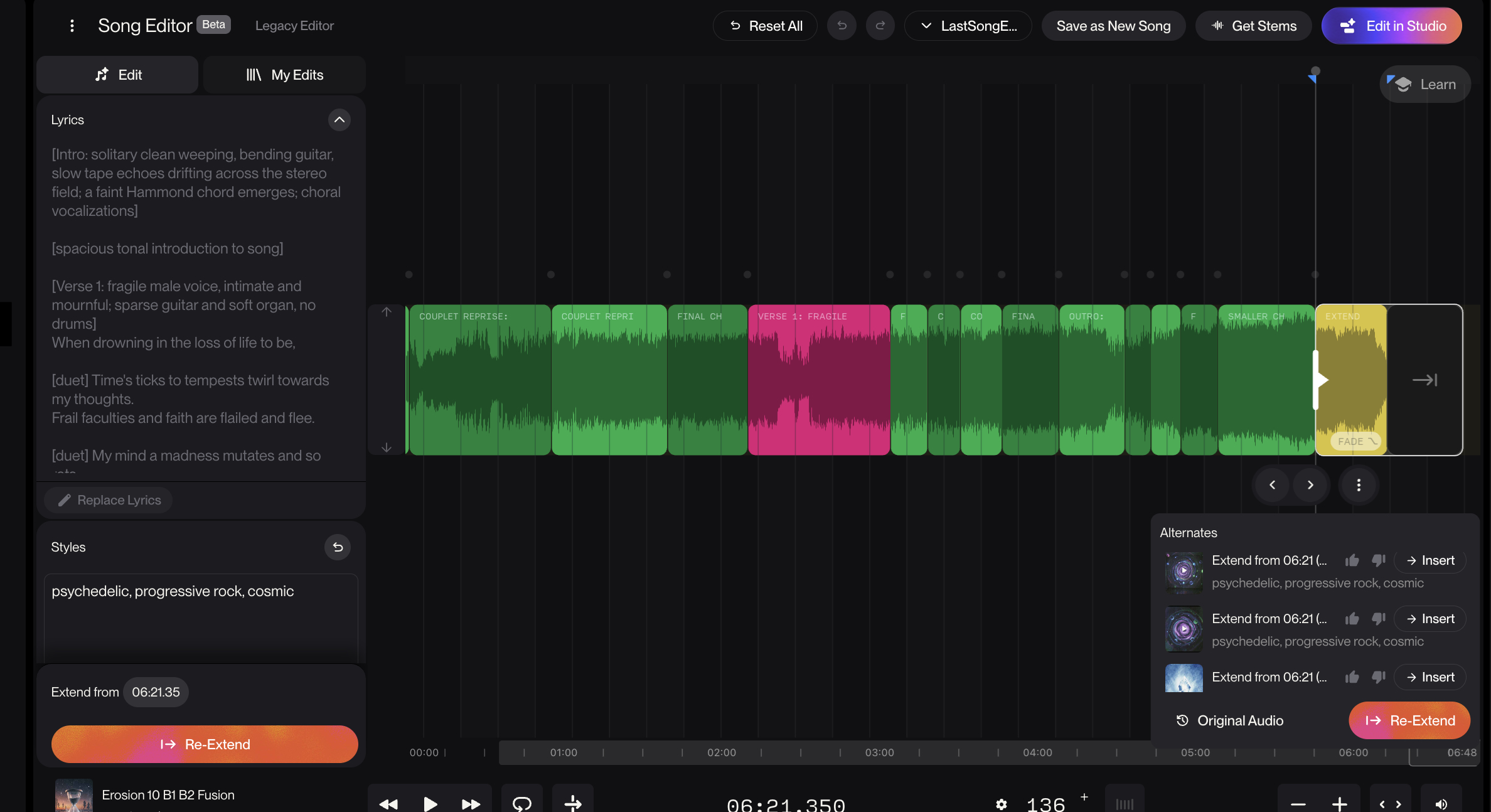
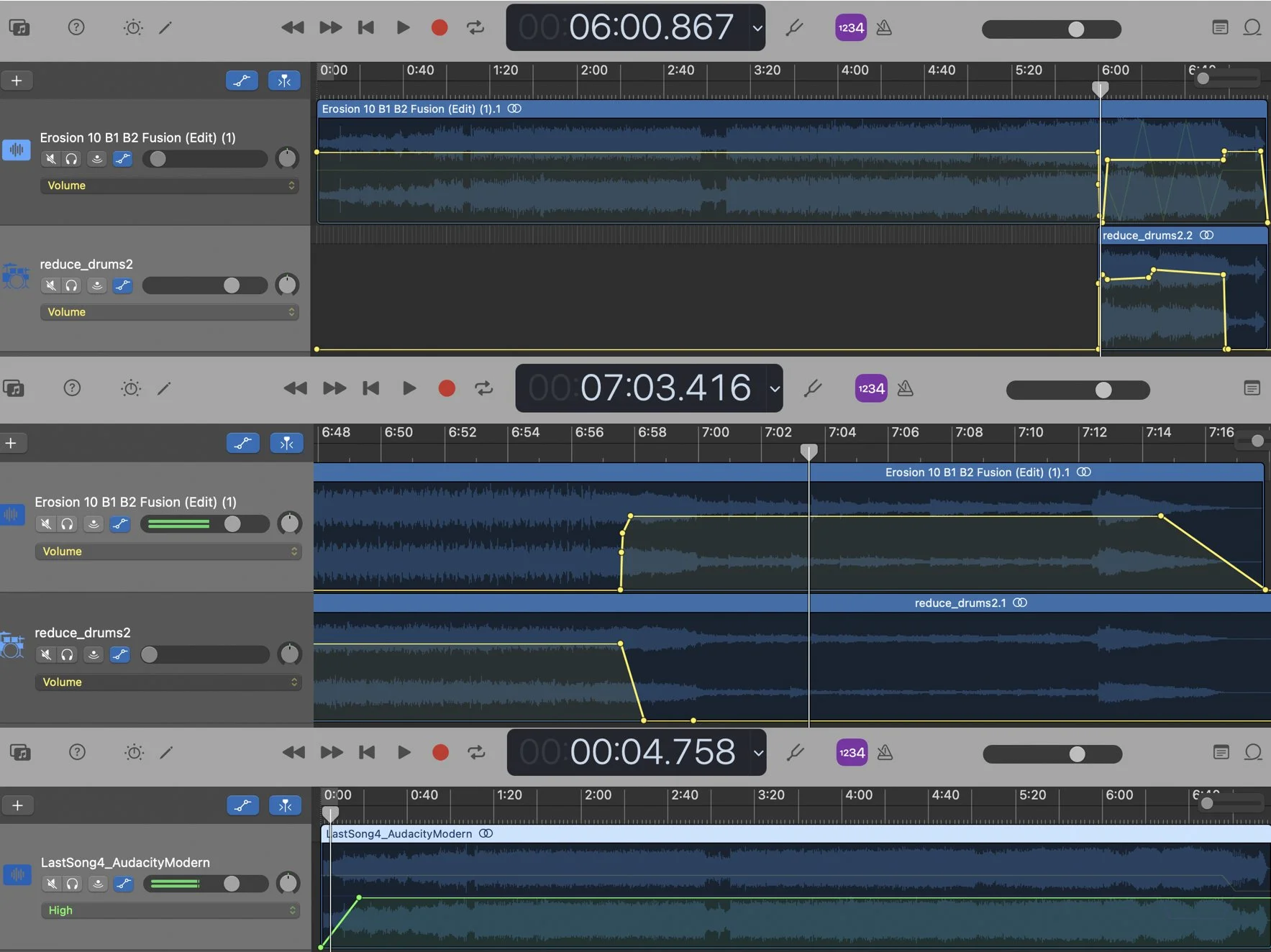
The combination consists of the music to the first two quatrains of the sonnet from one generation and the music of the third quatrain and couplet (with outro) of another generation, stitched together in Suno Studio, requiring another generation at the join between the two sections to harmonize/integrate the two portions. Roughly, I took the first third of one (0:00-1:48) and the second two-thirds of another (1:49-6:39). However, I did not like the ending of either song, and after combining them, I regenerated and extended the song (with 14 different generations before finding one that satisfied me) from approximately 6:21 in the combined version, producing a song from Suno with a different resolution that lasted until 7:18 (see the image from Suno Song Editor showing the work on the fusion, then named “Erosion” with B1 and B2 the two contributing generations). There was some post-generation work in GarageBand with stems (separated instruments) to decrease what were to me overpowering kick drums in the later portion of the combined song. Inversely, I enhanced the melodic bass line in the beginning. I also added frequency filters to reduce hiss, and rendered a perhaps ill-advised panning of sound toward the end. Finally, I used compression and normalization in Audacity to optimize sound levels across the song (see image below with stacked alterations of the sound in GarageBand).
I felt the first generation had a much more moving and memorable melody for the opening two quatrains, and the melodic bass was simply exquisite. However, the third quatrain, one of the most emotional, was so much more powerful in the second source generation in the combination. Hence, the specific fusion described.
Overall, this is a good example of what often goes into this for me: prompts and annotations, a sea of song generations, finding versions I like and sometimes making hybrids of them, and post-production that alters many aspects of the sound and instrument mix. There are many examples of song splicing to combine different generations. One Perfect Day is another example where the opening “incantation” to activate the emotional programming in David from the movie A.I. was handled very interestingly in one generation, but the rest of the song was much better from others (in fact, this song combined three different generations). There are many other examples, including several songs from the French language translation of Scripture (L’Écriture), where to make versions closer to the English original I needed to select portions from different generations and combine them and/or do stem editing (e.g., removing drums in beginnings where the English version has none, etc.).
Last Song for Stargirl Prompts
Style Prompt Song A:
Cosmic psychedelic progressive rock, slow 64–70 BPM with subtle odd-meter turns; fragile theatrical male tenor-baritone, restrained and intimate before rising into a choral crescendo; Mellotron strings and choir, Hammond organ, clean weeping electric guitar with long tape-delay answers, melodic bass, restrained acoustic drums and distant timpani; spacious late-60s/early-70s analog stereo, delicate panning, vintage tape saturation, organic dynamics, unresolved Mellotron decay
Negative prompt: ‑pop, ‑autotune, ‑compression, ‑metal, ‑shredding, ‑Glossy modern pop production, ‑brickwall limiting, ‑excessive compression, ‑harsh treble, ‑exaggerated sub-bass, ‑hard Auto-Tune, ‑quantized drums, ‑EDM synths, ‑muddy layering, ‑excessive reverb wash
Style Prompt Song B:
Cosmic psychedelic progressive rock, Mellotron strings and choir, Hammond organ, clean weeping electric guitar with long tape-delay replies, melodic bass, restrained acoustic drums and distant timpani; slow 64–70 BPM with subtle odd-meter turns; fragile theatrical male tenor/baritone, intimate to soaring choral prophecy; spacious late-60s/early-70s stereo, vintage tape saturation, organic crescendo and unresolved Mellotron decay,
Negative prompt: ‑pop, ‑autotune, ‑compression, ‑metal, ‑shredding, ‑Glossy modern pop production, ‑brickwall limiting, ‑excessive compression, ‑harsh treble, ‑exaggerated sub-bass, ‑hard Auto-Tune, ‑quantized drums, ‑EDM synths, ‑muddy layering, ‑excessive reverb wash
Lyric Annotations (identical for both, but different from the final generated music due to generative unpredictability):
[Intro: solitary clean weeping, bending guitar, slow tape echoes drifting across the stereo field; a faint Hammond chord emerges; choral vocalizations]
[spacious tonal introduction to song]
[Verse 1: fragile male voice, intimate and mournful; sparse guitar and soft organ, no drums]
When drowning in the loss of life to be,
[duet] Time's ticks to tempests twirl towards my thoughts.
Frail faculties and faith are flailed and flee.
[duet] My mind a madness mutates and so rots.
[Instrumental passage: guitar answers the vocal melody; chromatic organ harmonies unfold, melodic bass enters; Mellotron strings rise gently in the distance][Choral passage; stirring; haunting; stepping through moving chord progressions]
[Verse 2: opening melody returns with warmer, wider phrasing; restrained drums enter, choir hover behind the voice; guitar weeping interwoven with verse]
[duet] Each dawn new-dyed I lose you once again,
A scalpel slicing sharings - ever gone.
[duet] Entombed in eons, I can't comprehend
[choir] How stars' eyes still retain in me their bond.
[Extended instrumental journey: spacious guitar solo over moving bass and Hammond; tape-delay phrases answer across the stereo field; brief odd-meter transitions deepen the unease, then return to the slow pulse' swelling choral backing, climax]
[Bridge: heartbreaking, distinct new melody, questioning upward leaps and darker chord changes; continuous crescendo through all four lines]
[soaring choir] And who are you? Not she who loved me sure -
(Not she who loved me sure)
[plaintive] Soft angel's sounds still singing in my soul.
(You ever sing within my soul)
[soaring choir] She died in dreams. I failed to find a cure.
(I could not find your cure)
Tormenting doppelgänger twins tears toll.
(tears toll, they toll, they toll)
[Instrumental climax: choir background soars, anguished sustained guitar, surging Hammond, sweeping Mellotron strings, full acoustic drums and distant timpani; tension crests, then the ensemble falls away]
[Brief instrumental breath: fading echoes reveal a solitary softly picked guitar]
[Final couplet: almost whispered but fully sung, exposed solo voice, very quiet guitar]
Sick seasons smirk in sadist's irony,
As years fade yearning shards of memory.
[Couplet reprise: tender rising melody, close vocal harmonies enter; bass and Hammond return softly]
Sick seasons smirk in sadist's irony,
As years fade yearning shards of memory.
[Couplet reprise: expanding male and female choir, Mellotron strings and slow drums; broader phrases, gathering emotional force]
Sick seasons smirk in sadist's irony,
As years fade yearning shards of memory.
[Final choral statement: vast mixed choir in clear unified rhythm, lead voice soaring within the harmony; full ensemble, radiant dissonance and solemn timpani]
Sick seasons smirk in sadist's irony,
As years fade yearning shards of memory.
[Instrumental release: long expressive guitar phrase carries the choral melody; harmony slowly turns toward a haunting minor-key resolution][Outro: choir divides into answering groups; instruments gradually withdraw]
As years fade,
As years fade,
Yearning shards of memory.
[Smaller choir: softer descending harmonies; drums and timpani cease, electric guitar echoes recede]
Shards of memory
(They yearn)
Shards of memory
(They yearn)
[Close vocal harmonies: Mellotron fades, bass settles onto its final note; quiet Hammond and picked guitar remain]
As years fade,
Shards of memory.
[Final solo voice: intimate and fragile, original guitar motif returns; organ withdraws]
Shards of memory.
[Instrumental closing cadence: four quiet bars of solo guitar; lingering suspension gently resolves into a dark minor chord]
[Final chord rings out completely, echoes decay naturally into silence]
[Fade out to complete silence]
[Hold silence]
[End]
“SWEEPING across the country with the speed of a transient fashion in slang or Panama hats... comes now the mechanical device to sing for us a song or play for us a piano, in substitute for human skill, intelligence, and soul...
And now, in this the twentieth century, come these talking and playing machines, and offer again to reduce the expression of music to a mathematical system of megaphones, wheels, cogs, disks, cylinders, and all manner of revolving things, which are as like real art as the marble statue of Eve is like her beautiful, living breathing prototype...
When a mother can turn on the phonograph with the same ease that she applies to the electric light, will she croon her baby to slumber with sweet lullabys, or will the infant be put to sleep by machinery? Children are naturally imitative, and if, in their infancy, they hear only phonographs, will they not sing, if they sing at all, in imitation and finally become simply human phonographs – without soul or expression?”
—The Menace of Mechanical Music, Appleton’s Magazine, vol. 8, no. 3 (September 1906), pp. 278–284.
If photography is allowed to supplement art in some of its functions, it will soon supplant or corrupt it altogether, thanks to the stupidity of the multitude which is its natural ally.” -Charles Baudelaire, 1859